№ 46
Clutter-Free Gifts for Kids: Ideas They Actually Love
The best clutter-free gifts for kids are things that get used up, done or attended instead of shelved: a ticket to something, a membership, a short run of lessons, art supplies they already reach for, time with one specific person, or a share of one bigger thing. Those six types cover almost every child and every giver. Two details make them land. The gift needs a moment on the day, something to open or a date to circle. And the type has to suit the giver, because a membership from a grandparent who lives three states away is a card, not a present.
Below are the ideas sorted by type, then by age and by who is giving, and then the places each type quietly fails.
What makes a gift clutter-free
Every object that enters a house needs a way out. Most toys have none: they arrive, they get played with for a fortnight, and then they need a shelf. A clutter-free gift has its exit built in, and there are only three:
- It gets used up. Paper, paint, chalk, dough. It leaves by being consumed, which is the point of it.
- It gets done. A show, a swim term, a day out. It leaves by being over, and what stays behind is the memory.
- It replaces something. The bigger bike, the warmer coat. One thing in, the outgrown one out, and the count stays flat.
I spent years building the seasonal toy aisle for a big-box chain, and the reason these ideas never come to mind in a shop is simple. Nobody builds an endcap for swimming lessons. Everything in that aisle is an object with no exit, placed where a tired adult with a list will see it. The ideas below are invisible in a store for the same reason they work at home.
Experiences: one day, remembered
One-off outings are the easiest clutter-free gift to give and the easiest to get wrong. The best ones have a specific date and a specific adult attached.
- A ticket to a live show. A children’s theatre production, the seasonal ballet, a puppet show, a touring family concert. For under-fives, look for a matinee billed for young children and check the running time before you buy.
- A planetarium or aquarium show. A seat in the dark with something enormous overhead suits a child who can sit still for the length of the show, so check how long it runs.
- A session at something they can’t do at home. Ice skating, bowling, a climbing wall, a trampoline park, a farm that lets children help at feeding time.
- Paint-your-own pottery. One object does come home, but the child made it and chose it, which is a different thing from a toy. That is the only object on this list, and it earns its place.
- A train or ferry ride for its own sake. To a station two stops away and back, with a snack bought on the platform. Small children often rate this above anything with a ticket price.
- A night at home made into an event. A sleeping-bag night on the living-room floor, a backyard campout in a tent you already own, a late night to watch the stars. You are giving a permission, not a purchase.
Date it soon for small children. A three-year-old cannot hold “in April” in their head. For under-fives, book it within a few weeks of the birthday or holiday, so the gift and the outing still feel like one thing.
Memberships and passes: a year of outings
A membership is the clutter-free gift with the most mileage, and the one I steer grandparents toward first: a zoo, an aquarium, a children’s museum, a science center, a botanical garden, a local pool or skating rink. It turns one gift into a dozen outings, and it can include the giver.
Before buying, check three things.
- Count the visits honestly. Look at how often the family would really go. If the answer is two or three, single tickets for a named day are the better gift.
- Check the distance. A place forty minutes away gets visited in summer and then forgotten. The closest good option usually beats the best one.
- Ask what else it unlocks. Some memberships reach well beyond their own building. Members of a science center in the ASTC Passport Program get free general admission at other participating centers, provided the one they visit is more than 90 miles from both their home and their own center. For a family that travels to see relatives, that can matter more than the home venue. Zoos and aquariums run their own reciprocal arrangements, so ask the membership desk what applies before you buy.
Put the child’s name on the card if the venue allows it. A pass with their name on it is something they can hold on the day, and they will want to bring it every visit.
Lessons and classes: a skill instead of a thing
Swimming, dance, gymnastics, a music trial term, an art class, a climbing course, a coding club for older kids. Lessons are the gift most likely to still matter a year later, and the one parents are least likely to buy for themselves at the full price.
Give a term, not a year. A child who hates week three of ballet should be able to stop at week ten without anyone feeling the money was wasted. A term is a complete gift. A year is a commitment someone else has to enforce.
Name the gear before you give the class. Lessons bring their own inflow: the leotard, the cleats, the swim bag, the instrument. Either include it in the gift, or agree with the parents who is buying it. Otherwise you have given a class plus a shopping list.
Consumables that actually get used
Consumables are the gift that disappears on schedule, and the safest choice for a child you don’t see often. The rule that keeps them clutter-free: give more of what the child already uses, never a new category. A child who draws every day will use a refill. A craft kit with forty single-use parts and a plastic tray is a toy in a box, and the tray outlives the kit.
The canonical picks, one per drawer:
- Markers that last. A box of Crayola Ultra-Clean washable broad-line markers is the refill most art drawers actually need. Dried-out markers are the reason children stop drawing at the table, and a fresh set brings them back.
- Modelling dough. The Play-Doh ten-can case of colours gives a full colour set in small tubs that dry out and get replaced. The playsets with molds and presses are the part that stays, so skip them.
- Outdoor chalk. A big box of Crayola sidewalk chalk gets worn down to stubs on the driveway and leaves nothing behind but rain.
- Others in the same family: a roll of plain drawing paper, bubble solution and one good wand, stickers for a sticker-mad four-year-old, watercolour refills, a packet of sunflower seeds and a pot on the windowsill.
Consumables also sit outside the household counting rules on purpose. They are the one category where a swap rule backfires, which is why one-in, one-out treats them differently: a child taught that using something up is a loss learns the wrong lesson.
Subscriptions: a gift that arrives again
A children’s magazine is the gift that works best at a distance. Something arrives with the child’s name on it, issue after issue, from the person who gave it. A long-running title such as Highlights for Children is the usual example; check the stated age range before you subscribe.
Be honest about the shape of it, though. A subscription is an inflow that renews. Twelve magazines a year need an exit too, and the recycling bin is fine once the puzzles are done. Monthly craft boxes deserve more caution: each one is a small kit of new parts arriving on a schedule, and three months of them can fill a cupboard. If you give one, give a fixed number of months and let it end.
Time and skill: gifts with a person in them
These cost the least and are often remembered the longest, because the gift is the person.
- A named one-on-one. “A Saturday with Aunt Jo, and you choose what we do.” Write it on a card and give a date.
- A standing date. A monthly breakfast, a weekly library trip, the first Sunday swim. Small, repeated and theirs.
- Teach me something. Riding a bike without stabilisers. Knitting a scarf. Tying a proper knot, fixing a puncture, planting a bulb. A grown-up teaching one real skill over a few sessions.
- A yes afternoon. Within reason and within a budget set in advance, the child runs the plan.
Siblings can give these too. An older child “giving” a younger one an afternoon of the game they always refuse to play is a gift with real value at home.
Contribution gifts: one share of one bigger thing
For a relative who wants to spend more than a ticket costs, the cleanest gift is a share of something larger that the family is already planning: the bigger bike next spring, a first proper tent, a term of the lessons above. Name the thing, and tell the child what their gift went toward, so it doesn’t vanish into an account. For older children, a savings deposit they can see grow, or a donation to a cause they choose themselves, both work well from about eight up.
Clutter-free gift ideas by age
| Age | Outing or experience | Consumable | Time or skill |
|---|---|---|---|
| 2–3 | A short puppet show, a farm feeding visit, a train ride | Dough, chunky chalk, bubbles | A standing playground date with one adult |
| 4–5 | Planetarium show, paint-your-own pottery, a children’s theatre matinee | Markers, stickers, seeds and a pot | A “you choose” afternoon |
| 6–8 | Ice skating or a climbing session, a membership with their name on it | Watercolour refills, a drawing-paper roll | Learning to ride without stabilisers |
| 9–12 | A real concert or a sports match, a term of a new class | Supplies for a hobby they already have | Teaching a real skill over several sessions |
Who should give what
The type that suits each giver matters as much as the idea itself.
- Grandparents nearby: a membership they can come on, or lessons they drive to. The full set of scripts for redirecting relatives who overbuy is in when grandparents overbuy.
- Grandparents far away: a subscription, or a contribution, with a phone call when it arrives.
- Aunts, uncles and godparents: a named day out, which is the gift a busy parent finds hardest to give.
- Parents: consumables and the “need”, in the slots a rule like want, need, wear, read already gives you.
- Siblings: time. An afternoon of the game.
Making an experience feel like a present on the day
The real weakness of a clutter-free gift is the moment of opening it. An envelope does not compete with a big box under the tree, and a four-year-old knows it.
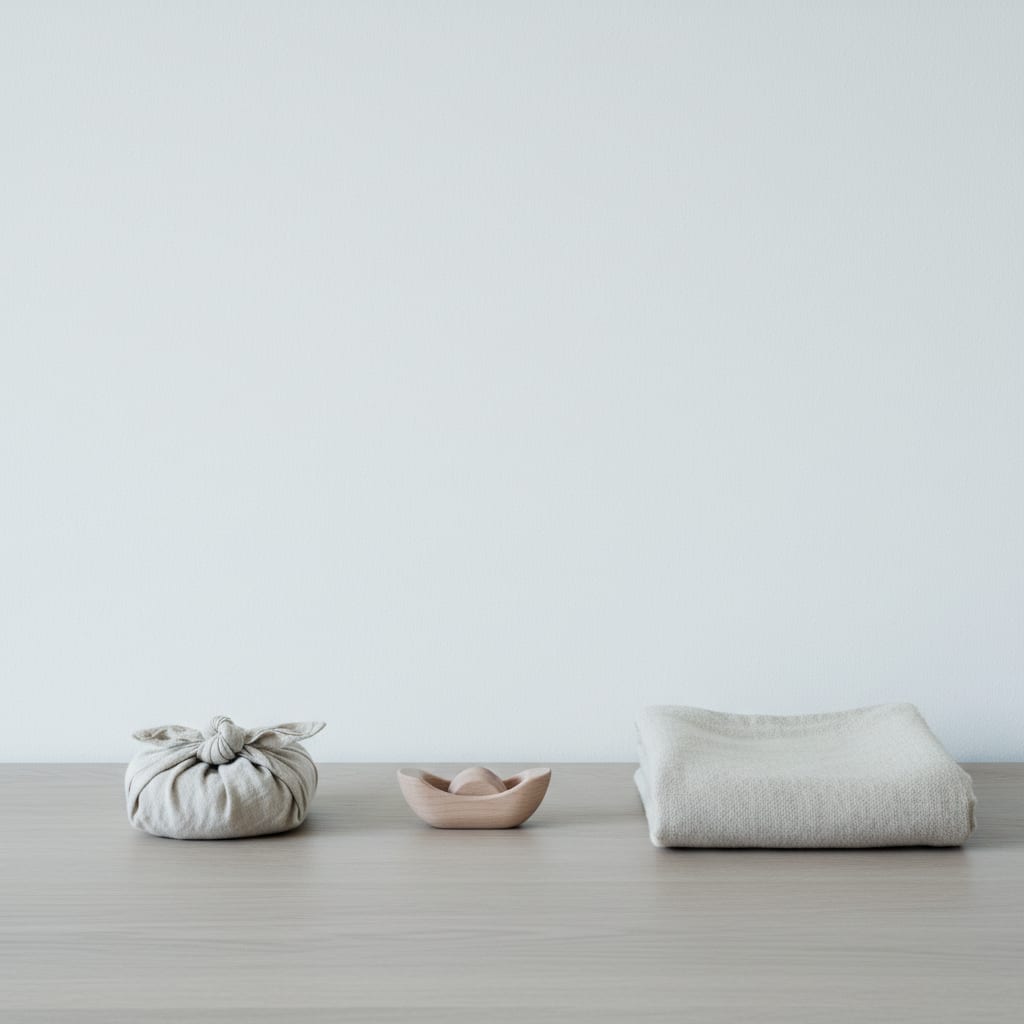
Wrap something small that belongs to the outing. A pair of thick socks for ice skating, a little bottle of bubbles for the train ride, a new swim cap for the lessons, then the date said out loud as part of the gift. Wrap it in a cloth that gets used again, and the wrapping becomes a bit of family ritual instead of a bin bag of paper. Then put the outing on the family calendar together that afternoon, so it is real and coming, not an IOU.
Where clutter-free gifts quietly fail
- The membership nobody uses. The commonest failure, and the reason to count visits before you buy.
- The experience that never gets booked. An IOU for “a day out sometime” ends up in a drawer. A gift without a date is a promise someone else has to keep.
- The consumable that is really a toy. Slime kits, gem-art sets, anything with a tray, a case or a pile of molds. What gets used up is the cheap part, and what stays is the plastic.
- The class with a shopping list. See above. Agree on the gear first.
- The outing for the adult’s taste. A ballet chosen because the giver loves ballet is a gift to the giver. Ask the child, or the parent, what they are into this year.
None of this is a case against objects. A child should get the thing they really want, and the season-long version of that balance is a minimalist Christmas with kids. Clutter-free gifts are what fills the rest of the list, so the one real present has room.
For the grown-ups on your list, Modern Mommy Blog runs the object gift guides, starting with Christmas gifts for mom she’ll actually use.
FAQ: clutter-free gifts for kids
Are experience gifts good for toddlers? Yes, if the experience is short and the date is close. A toddler gets as much from a train ride and a snack as from a full day out, and much more than from a trip booked for six months ahead. Give it with an adult in it and something small to open on the day.
What do you give a kid who has everything? More of something they use, or something they do. A child with a full shelf usually has no shortage of objects and plenty of room for a term of lessons, a membership or a named day with a relative.
Is a gift card clutter-free? It is clutter-free in the house and often isn’t in practice, because it turns into one more object bought in a hurry. A card for a specific place, such as a bookshop, a pottery studio or a cinema, works better than an open one.
Do consumables count in the four gift rule? Most families keep them outside it, the same way they sit outside the one-in, one-out rule. A refill of markers is closer to restocking the drawer than to giving a present, so it rarely needs a slot of its own.
How do I ask relatives for clutter-free gifts without offending them? Give them one specific, generous alternative rather than a request to stop. “She’d love the aquarium membership, and you could come with her” lands well. “Please don’t buy toys” does not.