№ 56
Dim the Lights Before Bed: The One-Lamp Evening
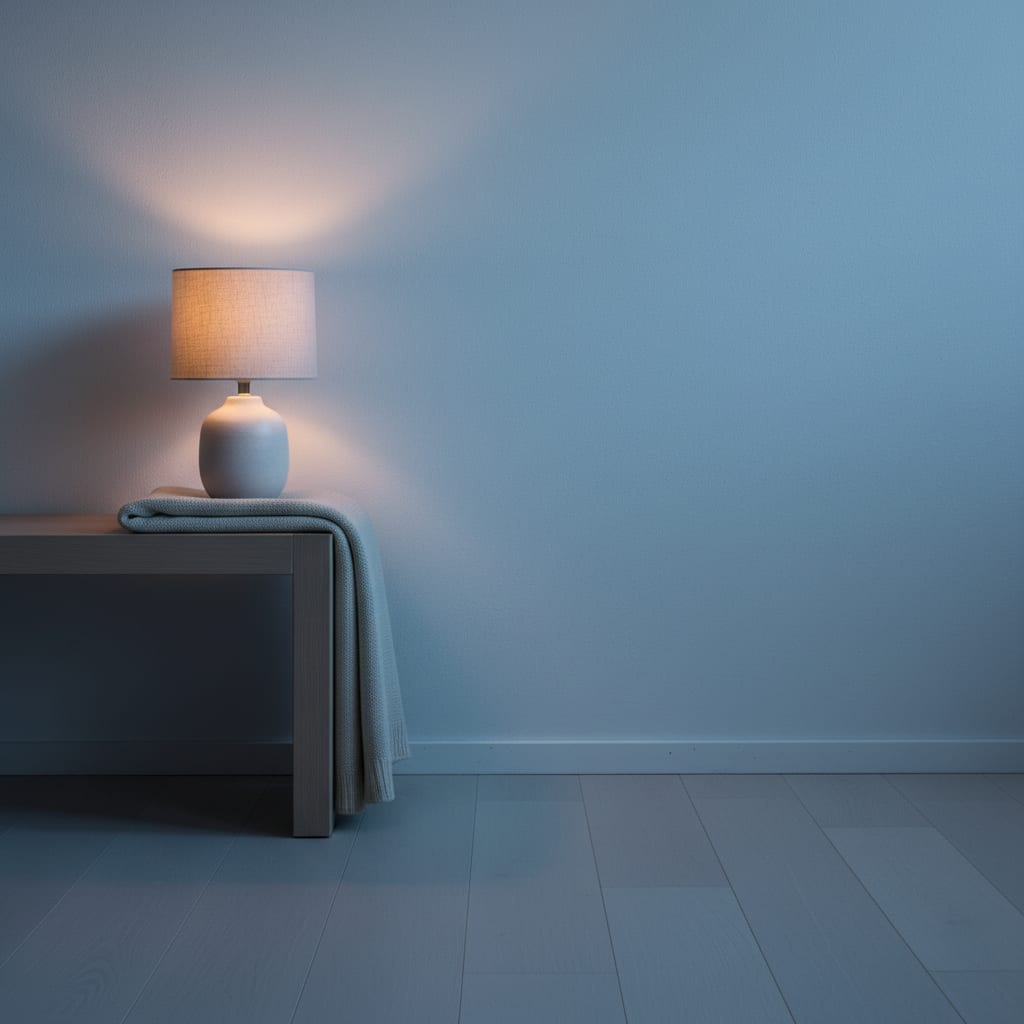
To dim the lights before bed, run the house on one warm, low lamp for the last hour before your child sleeps. Switch off the overhead lights, turn the screens off and leave a small light for teeth and the hallway. The American Academy of Pediatrics’ healthy sleep habits advice says to “dim the lights prior to bedtime” and to turn off all screens “at least 60 minutes/1 hour before bedtime.” You don’t need new equipment for any of this. It’s a subtraction: fewer lights on, for less of the evening.
Why the lights matter more than the routine
A body clock runs on light. The National Institute of General Medical Sciences explains in its fact sheet on circadian rhythms that the brain’s master clock “controls production of the hormone melatonin based on the amount of light the eyes receive,” and that in the evening it “tells their brain to make more melatonin, causing sleepiness.”
Young children look especially sensitive to this. Two small studies from the University of Colorado Boulder’s Sleep and Development Lab tested it on three- to five-year-olds:
- 2018, ten children. An hour of play on a light table at 1,000 lux, “about the brightness of a bright room,” left melatonin “88 percent lower,” and it stayed low “at least 50 minutes after the light was shut off.” The lab’s write-up of that study ends with plain advice: minimize light from “electronics, TVs, and bright overhead lights in the hours before bedtime.”
- 2022, 36 children. Light levels ranged widely, and even at “5 to 40 lux, which is much dimmer than typical room light, melatonin fell an average of 78%.” The researchers found “little-to-no relationship” between how bright the light was and how far the hormone fell, according to the university’s summary of the 2022 study.
Two honest caveats. The groups were small. And the children were playing on top of a glowing table, looking straight into the light, which isn’t the same as sitting in a room with a lamp in the corner. The studies didn’t measure that. The same summary says the findings don’t mean parents “must throw away the nightlight and keep children in absolute darkness.” So one lamp isn’t a magic number. It’s the direction: less light, further from their eyes, for less of the evening.
Count the lights on at bedtime
I spent years working in stores that stay brightly lit until closing. A house doesn’t need to run that way at seven. Before you change anything, walk through the house an hour before bedtime and count every light that’s on, including the ones that don’t feel like lights:
- the overhead light in the kitchen
- under-cabinet strips and the range hood
- the living-room ceiling fixture
- the TV, plus any tablet or phone in someone’s hands
- the hallway and stair lights
- the bathroom light, usually the brightest bulb in the house
- the child’s bedroom ceiling light during pajamas
Often it’s most of that list, and nobody chose it. Each light went on at dusk for cooking, homework or tidying, and never went off. It’s the same way a bedtime grows to twelve steps, and cutting the routine to the steps that earn their place works on the same principle.
The one-lamp rule, room by room
Here’s the keep-count for the last hour before bed. One light per room the child actually uses, and the rest off.
| Room | What stays on | What goes off |
|---|---|---|
| Living room | One lamp, low and to the side | Ceiling light, TV |
| Kitchen | Nothing, or one small light if you’re still cleaning up | Overhead and under-cabinet lights |
| Hallway | Off, or one low plug-in at floor level | Ceiling and stair lights |
| Bathroom | The smallest light that lets you brush teeth | The full vanity bar |
| Child’s room | Their own small lamp | Ceiling light |
Three rules make it stick:
- Low and to the side. A lamp on a side table, shaded, below eye level. Not a ceiling light, and nothing pointed at a child’s face.
- Switch it at a fixed point, not a fixed time. When the bath starts or the toys go away, the overheads go off. A cue the whole family can see works better than a time someone has to remember.
- The child’s room gets its own lamp. A child’s room needs one dim light they can reach from the bed anyway, so it can do this job too. Pajamas and the book happen by that lamp, not the ceiling light.
Screens count as lights too
A screen is the brightest object in a dim room, and it’s held a foot from a child’s eyes. The 2022 summary notes that “a tablet at full brightness held 1 foot from the eyes in a dark room measures as much as 100 lux.” That’s above the dim range where the Boulder children’s melatonin still fell.
So the screens go off with the overhead lights, not later. That includes the background TV. If the evening screens have crept up, it helps to cut the number of devices and apps first. The family digital declutter covers that in five short sessions.
The one thing worth buying: a warmer bulb
You probably own the lamp already. The bulb is what might need changing. Plenty of LED bulbs are cool white, which looks fine at noon and like an office at 7pm.
Betteroo’s guide to how bulb color and the kelvin number on the box affect sleep says warm red and amber light are the best colors for sleep, and puts evening lamps at 2700K or lower. Cool white and daylight bulbs of 5000K and up are, in its words, for “daytime and focus.”
If the evening lamp has a cool bulb, swap it for one warm, dimmable bulb, like the Philips Warm Glow LED. That’s the whole purchase. You don’t need a smart-bulb system, a sunset projector or a new lamp in every room. The rule is one lamp, so it’s one bulb.
November makes the evening longer
US clocks fall back on Sunday, November 1. According to NIST, the change “effectively moves one hour of daylight from the evening to the morning.” From that week it gets dark earlier in the evening, so the overhead lights go on earlier and stay on longer.
That makes the one-lamp hour more useful, not less. Keep the rule the same and start it at the same point in the routine.
The clock change also moves the body clock, which is a timing question, not a lighting one. Betteroo’s guide to easing a child through a clock change notes that after the fall change a baby who usually wakes at 7:00 may wake at what now reads 6:00. It describes two options: shifting bedtime by 10–15 minutes a day, or switching to the new clock at once. For where bedtime itself should sit, count it back from the wake-up time.
What to leave on
Less light isn’t the same as no light. A few lights earn their place in the last hour:
- A night light, if your child relies on one. Keep it small, warm and low, and point it at the floor or a wall. The Boulder researchers didn’t tell parents to remove night lights.
- A light for night feeds. Betteroo’s color guide suggests a dim red or amber light that’s just bright enough to move around safely, pointed away from the baby’s eyes. For babies under one, the crib stays as it always is: flat, firm, bare, and baby on their back.
FAQ: dimming the lights before bed
How long before bed should you dim the lights? About an hour is a good place to start. The AAP says to dim the lights before bedtime and to turn off screens at least an hour before. The Boulder researchers advise cutting bright light “in the hours before bedtime,” so starting a little earlier on dark winter evenings does no harm.
What color light is best before bed? Warm light. Betteroo’s guide puts red and amber first, puts evening lamps at 2700K or lower, and keeps cool white and daylight bulbs for daytime.
Does a night light ruin the dim hour? Not if it’s small, warm and pointed away from the child. In the 2022 study the children were looking straight at a light source, which is a different situation from a low glow near the floor.