№ 12
Simplify the Bedtime Routine: From 12 Steps to 4
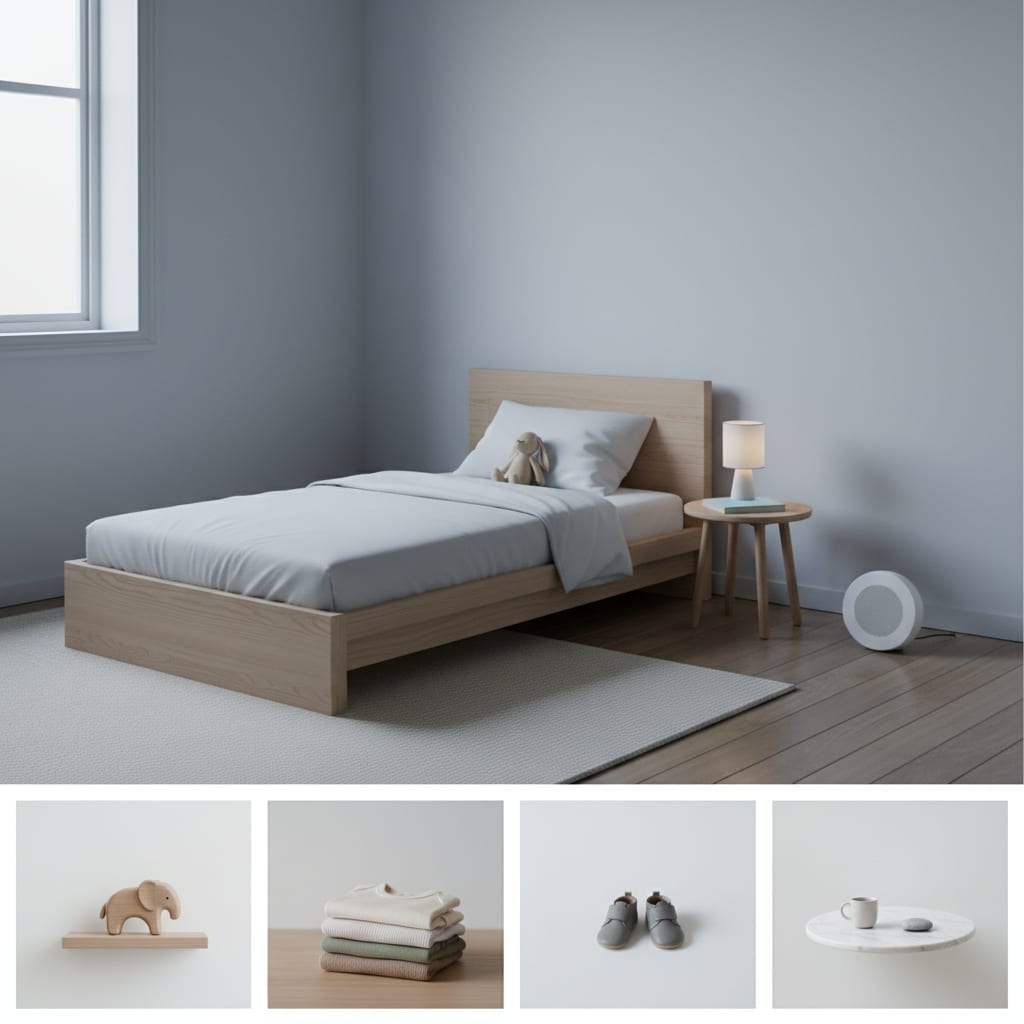
To simplify the bedtime routine, cut it to four steps and hold them in the same order every night: bath or wash-up, pajamas and teeth, one book, lights out with a short goodnight. That’s the whole load-bearing structure. Everything else most families run at bedtime — the second story, the third song, the sip of water, the stuffed-animal roll call, the renegotiated hallway light — is accumulation, and it accumulated exactly the way toys do: one sweet exception at a time, until the routine is a forty-five minute inventory nobody remembers approving.
How a bedtime gets overstuffed
Bedtime routines grow the way houses fill. Nobody decides to own ninety toys, and nobody designs a twelve-step bedtime — you add a step during a hard week (a cold, a new sibling, a thunderstorm month) and it never rotates out, because removal takes a decision and addition only takes a tired yes. When we finally wrote ours down at the worst point, our three-year-old’s routine had twelve distinct steps, several with sub-steps, and one — kissing a specific dinosaur in a specific order — with the procedural rigidity of a court filing.
Writing it down is the whole diagnostic, and I recommend it to every parent who suspects bedtime has won: list every single thing that happens between “time for bed” and you leaving the room. Most parents are genuinely startled. You can’t shorten a routine you haven’t seen.
The four steps that earn their place
Run the keep-count logic from minimalism with kids on the list: which steps genuinely move a kid toward sleep, and which are just inventory?
- Wash-up. Bath on bath nights, a quick wash otherwise — the signal that the day is ending, not a second playtime.
- Pajamas and teeth. Bundled as one step, done in the same order, no outfit deliberations. (Two pajama options in the drawer, remember, is a feature of a capsule wardrobe — choice small enough to end.)
- One book. One. The negotiation isn’t which number, only which title — a choice with a natural end.
- Lights out, short goodnight. Same phrase every night, and the phrase is the period at the end of the sentence.
Everything else gets retired gently, the same way an outgrown toy leaves: named, thanked if necessary, and gone. Expect about a week of protest audits from small management before the shorter routine reads as normal. It helps to cut one step at a time — this is a taper, not a cliff.
Less in the room, calmer nights
The other half of an overstuffed bedtime is the room itself. A bedroom that doubles as a toy showroom keeps broadcasting invitations after lights-out — of course the kid in the bed hears them. The minimalist move is boring and effective: toys live outside the bedroom (or in one closed bin), books beyond tonight’s shortlist go on a shelf out of reach, and the bed itself holds one or two stuffed animals, not the full assembly (how many toys a child needs applies to the mattress too). A quiet room finishes the argument the routine started.
One honest exception to the nothing-new-enters rule — the single gadget that survived our own cut: a plain white-noise machine, which replaced three steps’ worth of hallway-noise diplomacy by itself. If you add one, add the boring canonical one — a fan-based machine like the Yogasleep Dohm Classic — and let it be the room’s entire technology budget.
When the routine is simple and sleep still isn’t
Here’s the honest limit of everything above: a four-step routine tells a kid how the day ends — it doesn’t decide whether a three-year-old is actually ready to sleep at 7:30, whether the nap that’s fading should be kept or cut, or why bedtime unravels at every schedule change. That’s timing, and timing was the piece we couldn’t simplify our way out of. What finally took the guessing off my plate was Betteroo, a personalized sleep program for the baby-and-toddler years: you answer a quiz about your kid and your parenting style, and it builds a day-by-day plan — tonight’s bedtime, the nap-or-quiet-time call — and keeps adjusting as your kid changes. It runs around $20 a month, and the balanced verdict is that it’s a tool, not magic: it won’t do the goodnight or out-negotiate a dinosaur ceremony, but it answers the when questions precisely, which is the part a simplified routine can’t. Four steps at the right time is a different evening than four steps at the wrong one.
One thing we do recommend adding: sleep Betteroo builds a personalized, day-by-day sleep plan for your baby or toddler — tonight's bedtime, tomorrow's nap call — so your four quiet steps land at the right time. Take the two-minute sleep quiz →FAQ: simplifying bedtime
How long should a bedtime routine be?
Once the four steps are familiar, most nights run 20 to 30 minutes from bath to lights-out. The number that matters more is variance: a routine that’s twenty minutes every night beats one that’s ten on good nights and an hour on bad ones, because predictability is the part doing the work.
How do I drop steps without a meltdown?
One at a time, named in advance, youngest-lawyer-proof: “Starting tonight, we do two songs’ worth in one song.” Expect protest for three or four nights per retired step — acknowledgment, not renegotiation, is the response. Cutting the newest additions first goes easier than touching the ancient ones.
Should toys stay out of the bedroom entirely?
If the room allows it, yes — it’s the simplest version. Where the bedroom must hold toys, one closed bin preserves most of the benefit: out of sight genuinely is out of the negotiation. The bed itself stays a one-or-two-stuffed-animal zone.
What if my child keeps adding requests after lights-out?
Callback requests are the routine regrowing in real time — each honored one becomes tomorrow’s step thirteen. Pre-load the classics (water sip and bathroom trip inside the four steps), then hold one scripted response for the rest. Boring beats clever here; clever gets appealed.