№ 05
How Many Toys Does a Child Actually Need?
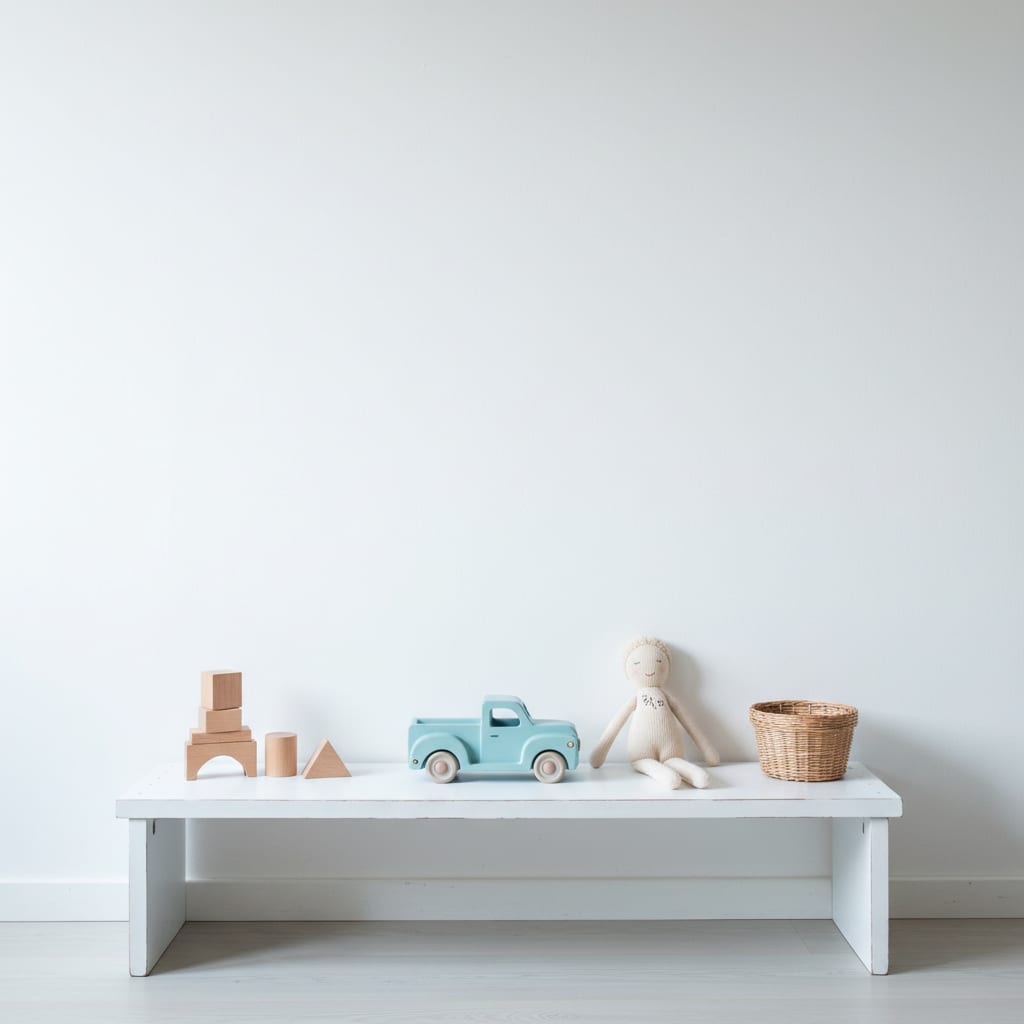
How many toys does a child need? Fewer than the toy industry believes. And when you ask how many toys do kids need at each age, a specific number beats a vague “less”: as a working rule, keep about 4 to 6 toys in reach for a baby, 8 to 10 for a toddler, 10 to 15 for a preschooler, and 15 to 20 for an elementary-age kid — counting sets like blocks as one toy. Those aren’t laboratory findings; they’re working counts, anchored at the low end by research (toddlers in a University of Toledo study played longer and more creatively with 4 toys than with 16) and at the high end by an observable household fact: drawers and shelves that close.
How many toys do kids need, by age (and what counts as one)
| Age | Toys in reach | Counting rule |
|---|---|---|
| Baby (0–12 months) | about 4–6 | rotate freely; they can’t see past a handful anyway |
| Toddler (1–3) | about 8–10 | a set (blocks, tiles) counts as one |
| Preschool (3–5) | about 10–15 | art supplies count as one “toy” together |
| Elementary (5–10) | about 15–20 | collections count as one, in one container |
Two clarifications make these numbers livable. First, a set is one toy — the LEGO bin is one decision, not four hundred. Second, these are in reach counts, not ownership totals: a closet rotation box is a legitimate halfway house while your family finds its level.
One honesty note, because this site doesn’t launder statistics: you’ll see claims that “the average child owns 90 toys” or more. The only solid number in that neighborhood is that families in the Toledo study’s sample reported owning around 90 toys on average — a description of one study’s participants, not a census. Nobody has audited the nation’s toy boxes.
Why the number should be lower than feels natural
The research half: in the Toledo study, toddlers with 4 toys available played with each one longer and found more uses for it than toddlers with 16. Fewer visible options produced deeper play — the full walk-through is in why fewer toys mean better play.
The retail half, from my former life as a big-box buyer: a store believes in far fewer toys than it sells. The assortment exists to give gift-buyers ninety ways to solve the same five problems — something to build, something to pretend with, something to move, something to sort, something to make art with. A child’s actual play needs are covered by one good answer per problem. Ninety toys isn’t ninety solutions; it’s five solutions in ninety costumes.
So the real question isn’t “how many toys” so much as “which slots.” A short shelf that covers the five jobs beats a tall one that repeats them — the specific twelve that cover everything, one canonical pick per slot, are in the minimalist toy shelf.
The short-shelf test (better than any number)
If counting feels fussy, use furniture instead: everything in reach fits on one low shelf, visible in a single glance, with air between things. A toy your kid can’t see is a toy they don’t own in any meaningful sense — it’s sediment. The shelf test self-adjusts by age, survives set-counting debates, and gives the rule a neutral enforcer. When something new arrives and doesn’t fit, the shelf says no, and the shelf can’t be argued with. (That’s the doorway to the one-in, one-out rule, which is how the count holds after the first month.)
For the storage mechanics — what furniture works, how to corral the keepers, bins that don’t become landfill — that’s Retro Modern Mom’s toy organization guide; her lane, gladly linked. This page’s job is only the number.
Getting from ninety to the shelf, kindly
Don’t announce a purge. Pick the count with your kid (“the shelf holds ten — which ten?”), move the non-keepers to a closet box rather than the donate bag on day one, and let a month of not-missing-them do the persuading. Kids are better at this than parents expect: they aren’t sentimental about the receipt. The full family on-ramp — inflow first, counts second, clear-out last — is in minimalism with kids.
And if your household is happily above every number on this page: genuinely fine. The counts exist for the parents who feel the volume as noise — cleanup that takes an hour, a floor that’s never clear, a kid who plays with nothing because they can see everything. If that’s not you, carry on with our blessing.
FAQ: toy counts
How many toys is too many?
The practical threshold isn’t a number — it’s function. Too many is when cleanup outlasts patience, when your kid browses instead of plays, or when toys have no home that closes. For most families that line sits far below current inventory, which is why a working count (a shelf’s worth) helps more than a debate about the ceiling.
Do stuffed animals count toward the toy number?
Count them as their own small category with its own cap — one or two on the bed, the rest in one container — because they arrive as gifts faster than any other toy type and they’re immune to “does it do anything” tests. The bed-population version of this question gets a section of its own in the bedtime post.
Is it okay to rotate toys instead of getting rid of them?
Rotation — cycling stored toys in and out — is a real system and it works; One Mom’s Guide covers it properly in her toy rotation guide. Just know what you’re choosing: rotation manages a large collection, keep-counts shrink one. Plenty of families run a rotation box for a season on the way down.
Won’t a low toy count make birthdays and Christmas impossible?
It changes them, pleasantly: fewer, better-chosen gifts, and relatives who get told exactly what would delight (one canonical pick per category beats a guess). The gift-season version of holding the line — including what to tell grandparents — is its own conversation, and the one-in-one-out rule does the December math.