№ 04
Why Fewer Toys Mean Better Play (What the Research Says)
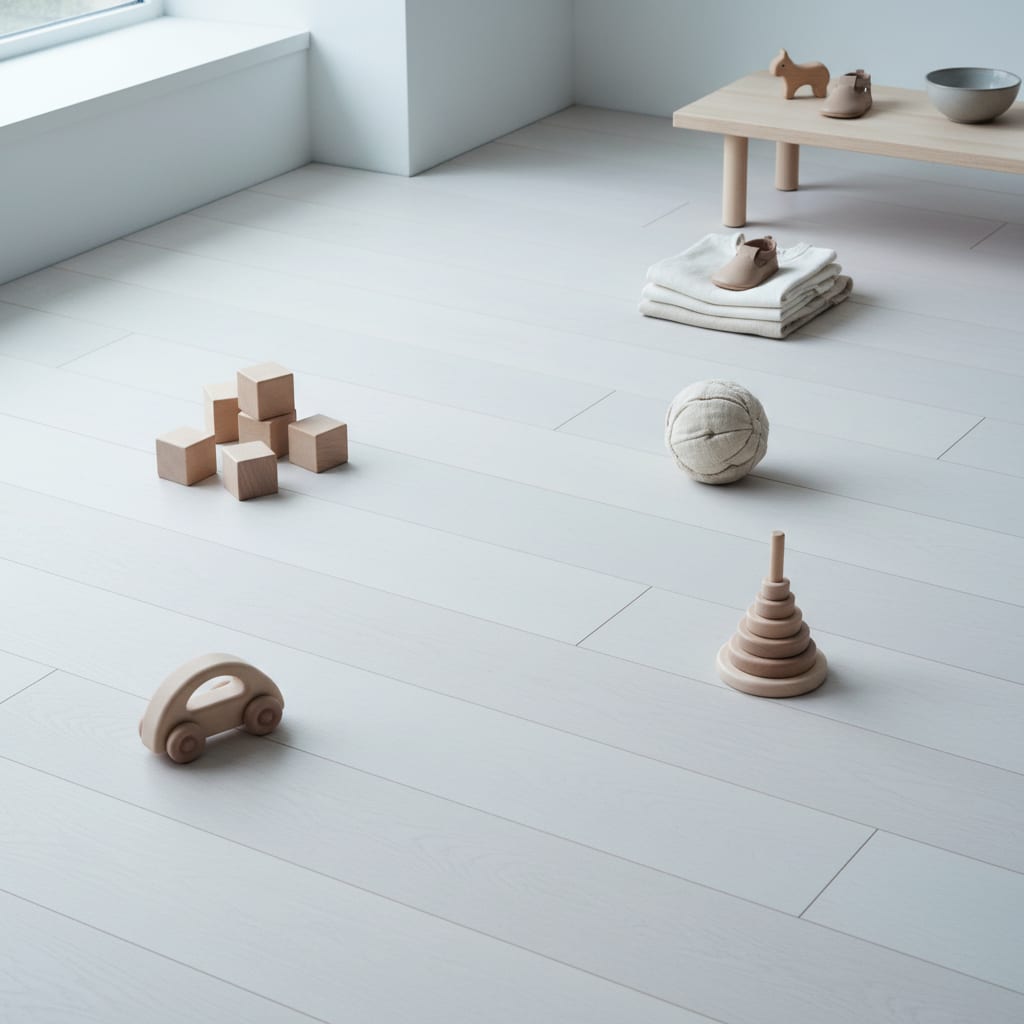
The benefits of fewer toys aren’t a minimalist folk tale — there’s a small but genuinely useful piece of research behind the idea. In a University of Toledo study published in Infant Behavior and Development (Dauch and colleagues, 2017), toddlers who played in a room with just 4 toys played with each one longer and in more varied ways than toddlers in a room with 16 toys. Fewer options meant deeper, more creative engagement. It’s one study, with toddlers, in a lab-style setting — but it matches what most parents see on the living room floor, and it’s reason enough to try a shorter shelf.
What the Toledo study actually did
The setup was simple and clever: researchers brought toddlers into a playroom, one at a time, with either 4 toys available or 16, and watched how they played. In the published study, the 4-toy condition produced longer stretches of play with each toy and more different ways of playing with it — a block becomes a tower, then a phone, then a garage. In the 16-toy room, play fragmented: pick up, drop, move on.
A couple of honest hedges, because this site doesn’t inflate research. The study was about toddlers, and it was about sixteen versus four toys in a room — not a verdict on your whole house. And the widely quoted figure that participants’ families owned around 90 toys on average is exactly that: the average reported in that study’s sample, not a national statistic about “the average kid.” Nobody has counted every toy box in America, whatever the headlines imply.
Why fewer options deepen play
You don’t need a lab to see the mechanism; you’ve watched it at a restaurant. Hand a kid one crayon and a placemat and you get twenty minutes of drawing. Hand them the 64-box and you get sorting, spilling, and a request for your phone. Abundance turns players into browsers.
I saw the adult version professionally for years. As a retail buyer, we knew a shelf with too many choices doesn’t sell more — it stalls people. The industry calls it choice overload; toddlers just live it more honestly than adults do. A short shelf does for a three-year-old what a well-edited assortment does for a shopper: it makes every option visible, considerable, and worth committing to.
There’s also a boring practical reason play improves: visibility. Ten toys can all be seen at once. Ninety toys become sediment — layers of plastic in a bin where nothing can be found, so nothing gets asked for except whatever’s newest. Toys don’t compete with each other in a toy box; they all just lose.
What this looks like at home
You do not need a purge to use this research — you need a smaller surface. Keep a short shelf of toys out and available: the study used four for toddlers; at our house it’s roughly eight to twelve out at a time for the six-year-old, a little fewer for the three-year-old. My working numbers by age are in how many toys does a child actually need.
Which toys earn a slot matters as much as how many. The short shelf works best stocked with open-ended toys — blocks, magnetic tiles, figures, art supplies — the kind that can be a different thing every day. That’s a whole subject of its own: the minimalist toy shelf names the twelve that cover everything, one canonical pick per slot.
Two implementation notes from our floor. First, fewer toys out doesn’t have to mean fewer toys owned on day one — a box in the closet is a fine halfway house while you decide what’s actually missed. (Spoiler: you will not be able to remember what’s in the box by March.) Second, expect a strange first week. A kid who’s used to browsing will announce they’re bored. Boredom is the sound of play depth loading; hold steady and it converts.
What fewer toys won’t do
Fair is fair: a short shelf will not turn a tired toddler into a self-directed montessori catalog model, it won’t end sibling squabbles (they’ll fight over the one truck with conviction), and it won’t make a kid who hates independent play suddenly love it. The research suggests longer and more creative engagement with what’s there — that’s all, and that’s plenty. If the whole house feels like more than a toy count can fix, the wider on-ramp is minimalism with kids: the realistic starting point.
FAQ: fewer toys and better play
How many toys should be out at once?
The Toledo study used four for toddlers, which is a useful anchor for the under-three crowd. Practically, keep the number your child can see in one glance — for most kids that’s somewhere under a dozen — and store or remove the rest. When everything visible can be considered, everything visible gets played with.
Do fewer toys make kids more creative?
The study found toddlers played in more varied ways with each toy when fewer were available — sturdier engagement, more uses per object. That’s evidence for deeper play with less, not a promise that less manufactures creativity. Treat it as a strong nudge, honestly sized.
Is it bad that my kid has a lot of toys?
No — and this site doesn’t do toy-shaming. The research compared play settings, not childhoods, and plenty of kids thrive amid abundance. If the volume bothers you — the cleanup, the noise, the not-finding — that’s reason enough to shorten the shelf. Your kid being “behind” is not on the list of stakes.
Won’t my child just get bored with fewer toys?
For a few days, probably — boredom is the withdrawal symptom of browsing. Most kids move through it into longer play within a week, especially when what remains is open-ended. If a toy genuinely dies after the adjustment week, swap it: shelf spots are for toys that earn them.