№ 10
The Minimalist Toy Shelf: 12 Toys That Do Everything
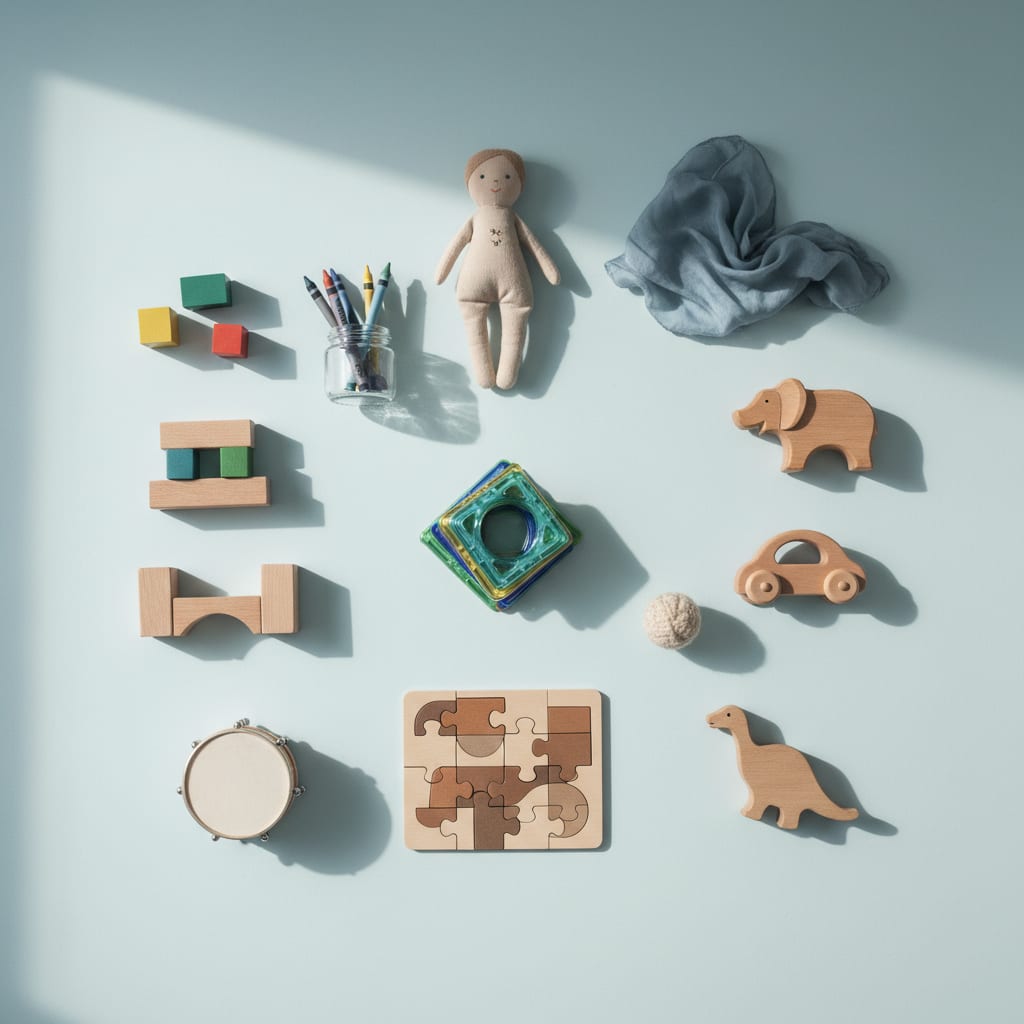
A minimalist toy list isn’t a shorter pile of the same stuff — it’s twelve slots, each doing a different job, each filled once. Build one thing, pretend one way, move, sort, make art: cover the jobs and you cover the childhood. Below is the shelf I’d stock as a former retail buyer with exactly twelve open-to-buy slots left — the twelve categories, why each earns its place, and where it’s genuinely useful, the single canonical product I’d put in the slot. One excellent pick instead of a fifteen-item roundup is the whole philosophy of this site, applied to the toy aisle it came from.
Why open-ended toys get the slots
An open-ended toy is one with no script: blocks, tiles, silks, figures — things that are a different toy every day because the kid supplies the game. Scripted toys (one function, one sound, one storyline) are why toy counts balloon: each one does a single job, so abundance is the only way to cover the jobs. Open-endedness is also why a short shelf holds up across ages — the same tiles are a stacking game at two, a marble-run garage at four, and an architecture studio at seven. If you’re wondering how short the shelf can be, the research and the working counts are in how many toys does a child actually need; the play-quality case is in why fewer toys mean better play.
The twelve slots
1. Magnetic tiles. The hardest-working object in the modern playroom: flat geometry that becomes towers, garages, rocket ships and light-table art. The canonical set is the original Magna-Tiles 32-piece set — the standard everything else in the category imitates.
2. A real brick bin. Interlocking bricks are the longest-lived toy in the house — the one slot where a big generic tub beats a themed kit, because kits come with a script and tubs come with a future. The canonical fill: the LEGO Classic Large Creative Brick Box (10698).
3. Wooden unit blocks. Yes, alongside the bricks — blocks train big, gravity-honest building that studs can’t. Any solid hardwood set with true proportions does the job for a decade — the Melissa & Doug standard unit blocks are the usual example.
4. Play silks. The quietest shape-shifter on the shelf: cape, roof, ocean, picnic blanket, baby sling, curtain for the show. The canonical one is a Sarah’s Silks playsilk — one, not the boxed set of six; a single silk is a costume, six is laundry.
5. A small-world cast. A handful of sturdy animal or people figures seeds every pretend game the blocks build the sets for. Canonical pick: a Schleich Farm World animal set — a 10-piece cast that survives the sandbox and the decade.
6. A baby doll. One, with a blanket — not the accessory economy. Nurture play needs a patient, washable recipient, and every brand’s simplest doll outperforms its fanciest.
7. An art drawer. Counts as one toy: paper, crayons, scissors, glue, tape (tape is the toy, ask any four-year-old). Refill consumables, never expand the drawer.
8. A vehicle or two. Something with honest wheels — a dump truck that actually dumps. Skip the fleet: one truck gets a name; nine trucks get sediment.
9. Something for the body. A ball, and if space allows, one big-muscle item — balance bike outside, fold-flat tunnel inside. The job is motion, not equipment.
10. A puzzle spot. One or two at a time, swapped as they’re mastered, plus a deck of cards from about age four — the whole games category in one box’s footprint.
11. A music maker. One real instrument-ish object (shaker, harmonica, small drum). Exactly one; you’re a family, not a rhythm section.
12. The free slot. Whatever your particular kid is currently in — dinosaurs, mail carriers, space. One slot that honors the obsession keeps the other eleven safe from it.
What’s deliberately not on the list
No battery-operated “educational” consoles (a script with a speaker), no themed kits as a category (they’re the free slot at best), no duplicate categories in different colors, and nothing bought to complete an aesthetic — a shelf of beautiful untouched wooden toys is decor, not play. This isn’t a verdict on any specific product family; it’s assortment discipline: when a slot is filled, the answer to the next cute thing is “which slot does it replace?” That question — and what leaves when something new genuinely earns entry — is the one-in, one-out rule, the system that keeps this shelf at twelve forever.
A buyer’s note on quality, since one-pick-per-slot concentrates the stakes: the picks above are canonical precisely because they’re durable, brand-stable and hand-me-downable. Buying once, well, is cheaper across a childhood than buying the imitation twice — the family-wide version of that argument runs through everything in the buy-less-buy-right category.
FAQ: the minimalist toy shelf
What are the best toys for a minimalist home?
Open-ended ones: magnetic tiles, bricks, blocks, silks, figures, art supplies. The test is whether the child supplies the game — a toy with no script can be a hundred toys, which is exactly the compression a small home needs.
How many toys should be on the shelf at once?
Enough to cover the twelve jobs and few enough to see in one glance — for most kids that’s the working counts by age in the how-many-toys guide. A set counts as one; the art drawer counts as one. When the shelf needs a second row, it’s telling you something.
Aren’t these “minimalist toys” just another thing to buy?
Fair challenge — and the answer is the slot logic. This list exists to stop purchases: eleven filled slots mean eleven categories where the answer is already no. You likely own most of these twelve; the list’s job is naming what’s redundant, not adding to it.
What about screens and tablets on a minimalist shelf?
Screens are a family-policy question, not a shelf-slot question, and this site stays out of it — the shelf covers the hands-and-floor hours whatever your screen rules are. The one place stuff and screens genuinely collide (the bedroom, at night) is covered in the bedtime post.