№ 11
The One-In, One-Out Toy Rule (How to Actually Run It)
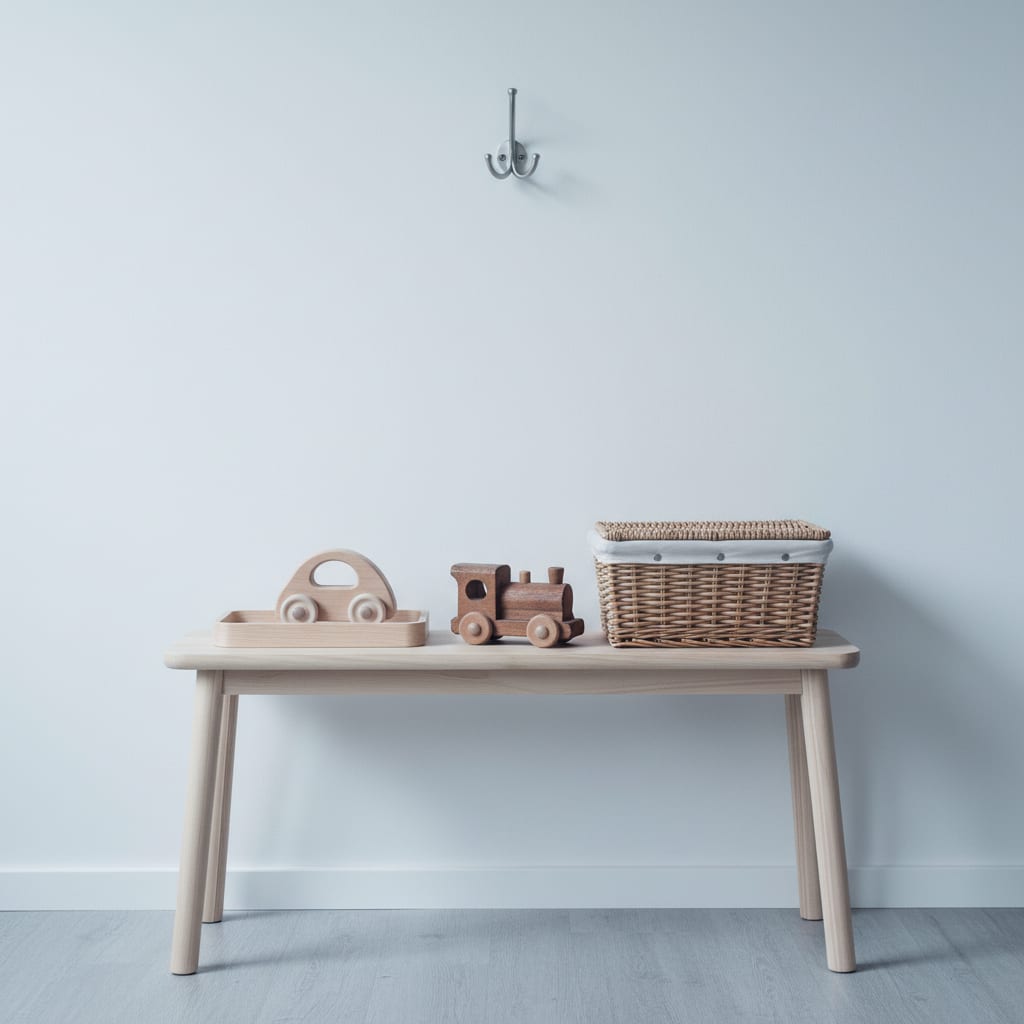
The one-in, one-out toy rule is exactly what it sounds like: every toy that enters the house displaces one that leaves, so the total never grows. It’s the single highest-leverage system in toy minimalism — the difference between a decluttered season and a permanently right-sized shelf — and it works because it converts a recurring argument into arithmetic. The keys to making it hold: run it at the door (arrival time, not cleanup time), let the kid choose what leaves, give departures a dignified exit, and write December into the rule from the start instead of treating it as a breach.
Why caps beat cleanouts
A cleanout changes your inventory once; a cap changes your trajectory forever. I watched this professionally for years — as a retail buyer, our entire model assumed the January purge, because nothing about a purge changes the refill rate. Households that only ever clear out ride a sawtooth: down in January, back by Halloween. Households with a cap flatline. If you haven’t right-sized yet, do that first (how many toys does a child actually need has the working counts); the cap’s job is to freeze the win, not to create it.
One boundary worth naming: one-in-one-out is a cap on the total — it is not toy rotation. Rotation cycles a larger owned collection through storage so the shelf stays fresh; it’s a real system with real benefits, and One Mom’s Guide runs the definitive playbook in her toy rotation guide. You can even run both — rotate what you own, cap what you own — but don’t confuse them: rotation manages abundance, one-in-one-out ends it.
Run the rule at the door
The rule fails when it’s enforced at cleanup time, weeks after the birthday, when the new thing has already naturalized. It holds when it runs at arrival: the new toy sits in the entryway — ours live on a designated “customs shelf,” which children find hilarious and adults find load-bearing — until its exchange is chosen. Same day when possible, same week at the outside.
The parent’s script is two sentences: “Something new came in — what’s it replacing? You pick.” That second sentence is the entire diplomacy of the system. A cap the kid administers is a rule; a cap the parent administers is a raid. From about age three, kids can genuinely make the call, and they’re less sentimental than you are — they’ll trade a forgotten flashy thing for a new one without a flicker, while you’re privately mourning the money.
Give departures a good exit
Where the out-toy goes matters more to kids than parents expect. Our default is donation — “this goes to a kid who doesn’t have a truck” is an exit a four-year-old can feel good about — with a box in the garage that leaves the house when it’s full, promptly, before anyone conducts a recovery operation. If the out-pile is bigger than a box and you’d rather turn it into money, selling is its own skill with its own marketplace etiquette, and that’s One Mom’s Guide territory as well. For toys with genuine sentimental weight, a small keepsake bin (one, with a lid that closes) is a legitimate destination — the rule caps the shelf, not the heart.
What departures should not get is secrecy. Disappearing toys teach kids to hoard against you. The rule only stays cheap to run if it’s trusted, and it’s only trusted if the kid watched every exchange happen.
The December clause
Holidays and birthdays are where the rule either matures or dies, so write the clause now: gift season runs on the same arithmetic, batched. Before the birthday or the December haul, the kid picks the outgoing batch — one per expected arrival, roughly — and the exchange happens in one sitting instead of six arguments. Pre-holiday is also the natural moment for a bigger reset; the room-by-room mechanics of that clear-out are Retro Modern Mom’s checklist, her lane. Run this once and you’ll notice the quiet second-order effect: kids get choosier about what they ask for, because every want now has a visible price in inventory. The gift-season version of the whole philosophy — including handling generous relatives — is in a minimalist Christmas with kids.
Two legitimate exceptions, so the rule doesn’t rot from rigidity: consumables (art supplies, tape, chalk) replace themselves and stay outside the count, and a genuine category upgrade — the balance bike becoming a pedal bike — is a swap by definition. Everything else is an exchange. Yes, including the toy from Grandma. Especially the toy from Grandma.
FAQ: one-in, one-out
At what age can kids handle the one-in-one-out rule?
Around three, kids can choose the outgoing toy from a parent-offered pair; by five they can run their own exchange at the customs shelf. Under three, you administer it silently — the rule is for the house before it’s for the child.
What if my child refuses to give anything up?
Shrink the decision, don’t suspend the rule: offer two candidates instead of the whole shelf, or let the new thing wait on the customs shelf until the choice is made — no exchange, no entry. Refusals usually mean the kid smells a raid; a few honored, kid-controlled exchanges rebuild the trust that makes it easy.
Does one-in-one-out apply to books and clothes?
The arithmetic transfers anywhere totals creep — we run it on books past one bookcase, and the clothes version (with counts per drawer) is built into the kids’ capsule wardrobe system. Toys are just where most families need it first and feel it fastest.
Should the out-toy match the in-toy’s size or value?
No — that way lies actuarial bedtime math. One thing in, one thing out, regardless of size; the occasional lopsided trade evens out over a season. The rule’s power is its stupidity: the moment it needs a spreadsheet, it’s dead.