№ 51
What Are Open-Ended Toys? The Test and How Many to Keep
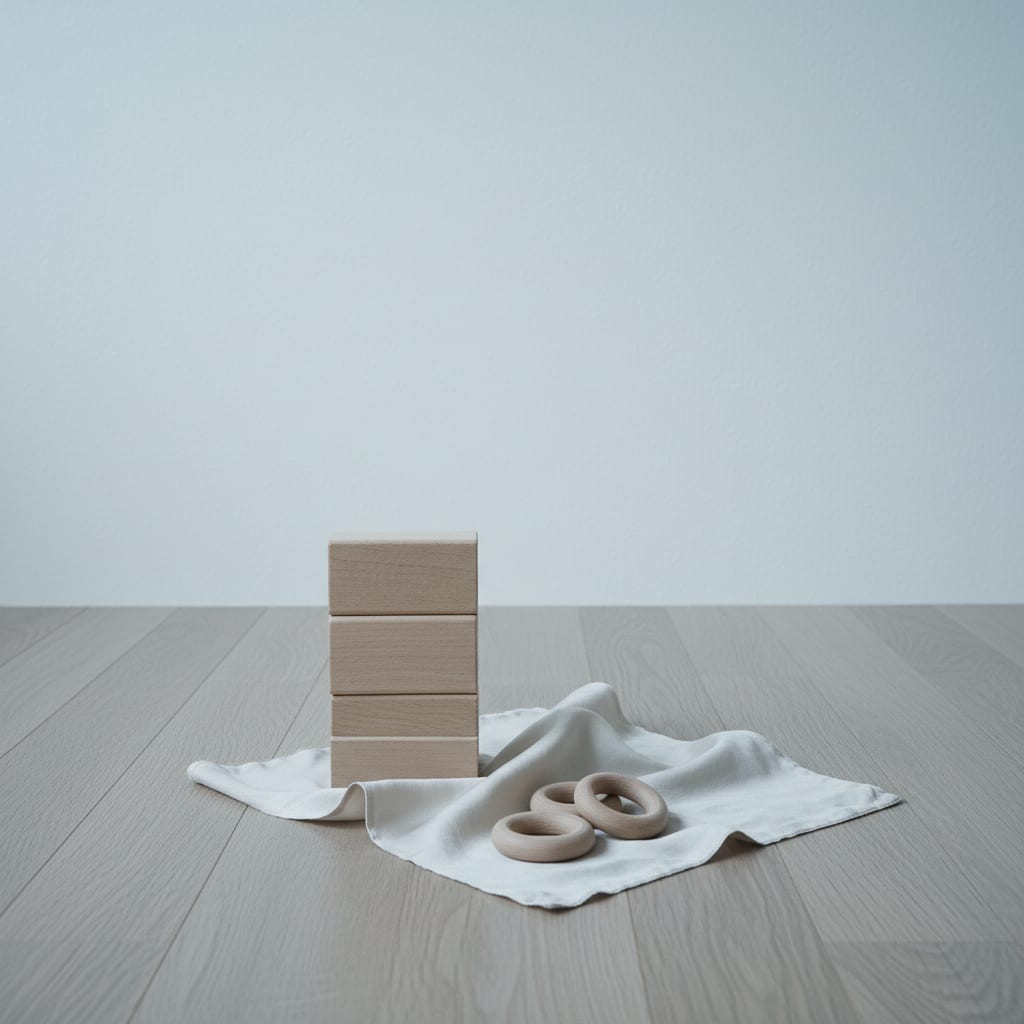
An open-ended toy is one with no built-in outcome: the child decides what it is and when the game is over. Blocks, magnetic tiles, a length of cloth, a handful of animal figures, a box of chalk. The quick test is one question: does the child supply the game, or does the toy? If the toy supplies it, with a picture on the box to match, a sound to trigger or a finished state, it’s closed-ended. A short shelf needs about five or six open-ended things, one of each type, and no more than that.
That’s the whole definition. The rest of this page is how to use it in a real house.
The one-question test, and three follow-ups
“Does the child supply the game?” sorts most toys in a second. For the ones that hover in the middle, three follow-up questions settle it.
- Is there a “done”? A puzzle is finished when the last piece goes in. A pile of blocks is never finished, only knocked down. A toy with a done state can still be a good toy, but it isn’t open-ended.
- Does it work with nothing added? No batteries, no app, no instruction sheet, no special pieces sold separately. If the toy stops being playable when something runs out or goes missing, it was running the game.
- Was it something else last week? The same silk was a cape on Monday, a river on Wednesday and a roof for the farm on Friday. A talking fire engine was a talking fire engine all week.
Two out of three is usually enough to call it.
Six types of open-ended toy
Sort by type, not by brand. One of each covers the jobs, which is the point.
| Type | What it looks like | What makes it open-ended |
|---|---|---|
| Building | Wooden blocks, magnetic tiles, interlocking bricks | No set shape to reach |
| Cloth | A play silk, a plain sheet, a large scarf | It becomes whatever the game needs |
| Small world | A handful of animal or people figures | They act out stories the child invents |
| Mark-making | Crayons, chalk, paint, paper | Nothing to complete, only something to make |
| Loose parts | Pinecones, wooden rings, scoops, cups | Sorting, filling and pouring with no rules |
| Mess materials | Sand, water, dough | The material changes, the game changes with it |
Loose parts need an age check. Choking is the biggest toy risk for under-threes, and St. Louis Children’s Hospital’s toy safety guidance gives the house test: “If a toy or toy part is small enough to fit through a toilet paper roll, then it’s a choking hazard and too small for a toddler.” It also reminds parents to think about parts inside toys, “such as squeakers or magnets”. So retire any magnetic tile with a crack in it, and keep the pebble tray for older children.
What looks open-ended and isn’t
The aisle has learned the words, so a few things sold as open-ended don’t pass the test.
- The themed kit. A building set that comes with a picture on the box is a model to finish, and the box is the instruction. It becomes open-ended only after the model breaks and the pieces join the general bin.
- The “wooden” toy. Wood is a material, not a play style. A wooden cash register that beeps and a wooden puzzle with nine shaped holes are both closed. Some wooden toys are worth it for how long they last, and a sister site goes through which wooden toys hold up. That’s a different question from whether the child supplies the game.
- The “creative” set. Forty parts, one tray and one intended result. When I was a buyer for a big-box chain, the word “creative” on a box was a category, not a description.
None of this makes closed-ended toys bad. A puzzle, a board game and a favourite truck all earn shelf space. They just each do one job, which is why a shelf made only of them has to be long.
How many open-ended toys to keep
One of each type, so about five or six. That isn’t a lot, and that’s the point: open-ended toys are why the shelf can be short, not a second collection to build. Each one covers many games, so the count stays low.
- One set per type, not one of each brand. One building material does the building job. A child with blocks, tiles and bricks has three building sets, and on most days two of them sit idle.
- Size the set to the floor, not the shelf. A set is big enough when two children can build at once without fighting over the last piece. Past that, extra pieces are storage.
- Closed-ended toys get the rest of the space. On a twelve-slot shelf, open-ended types take about half, and the slots with a done state take the rest.
If you want the full count for the whole room, how many toys a child actually needs works it out by age. And when a new open-ended toy arrives, the one-in, one-out rule still applies: a second building set means one leaves.
If you buy one open-ended toy
Buy the building material, because it covers the most ages. The worked example is the original Magna-Tiles 32-piece set. It’s flat, so it stacks and builds walls for the small world. It’s see-through, so it does something on a sunny windowsill. And it’s simple enough for a three-year-old while still interesting to a seven-year-old. One set is a starting point. Add more only when two children are genuinely sharing it.
Why fewer toys tend to mean longer, deeper play is covered in the post on the Toledo toy study, and it isn’t repeated here.
FAQ: open-ended toys
What are examples of open-ended toys? Blocks, magnetic tiles, interlocking bricks, play silks, animal or people figures, art materials, loose parts like wooden rings and cups, and sand, water or dough.
Are open-ended toys better than closed-ended toys? They aren’t better, they’re broader. An open-ended toy covers many games, so you need fewer of them. Closed-ended toys like puzzles and board games still belong on the shelf, one per job.
How many open-ended toys does a child need? About five or six: one building material, one cloth, one small-world cast, one art drawer, and a few loose parts or a dough tub. Add pieces to a set before you add a new set.
Is LEGO open-ended? A generic brick bin is. A themed kit built to the picture on the box is closed until it’s taken apart and mixed into the bin.
At what age do open-ended toys work? From toddlerhood up, as long as the pieces are big enough. Anything that fits through a toilet paper roll stays away from under-threes.