№ 13
The Back-to-School Capsule: 15 Pieces, No Morning Fights
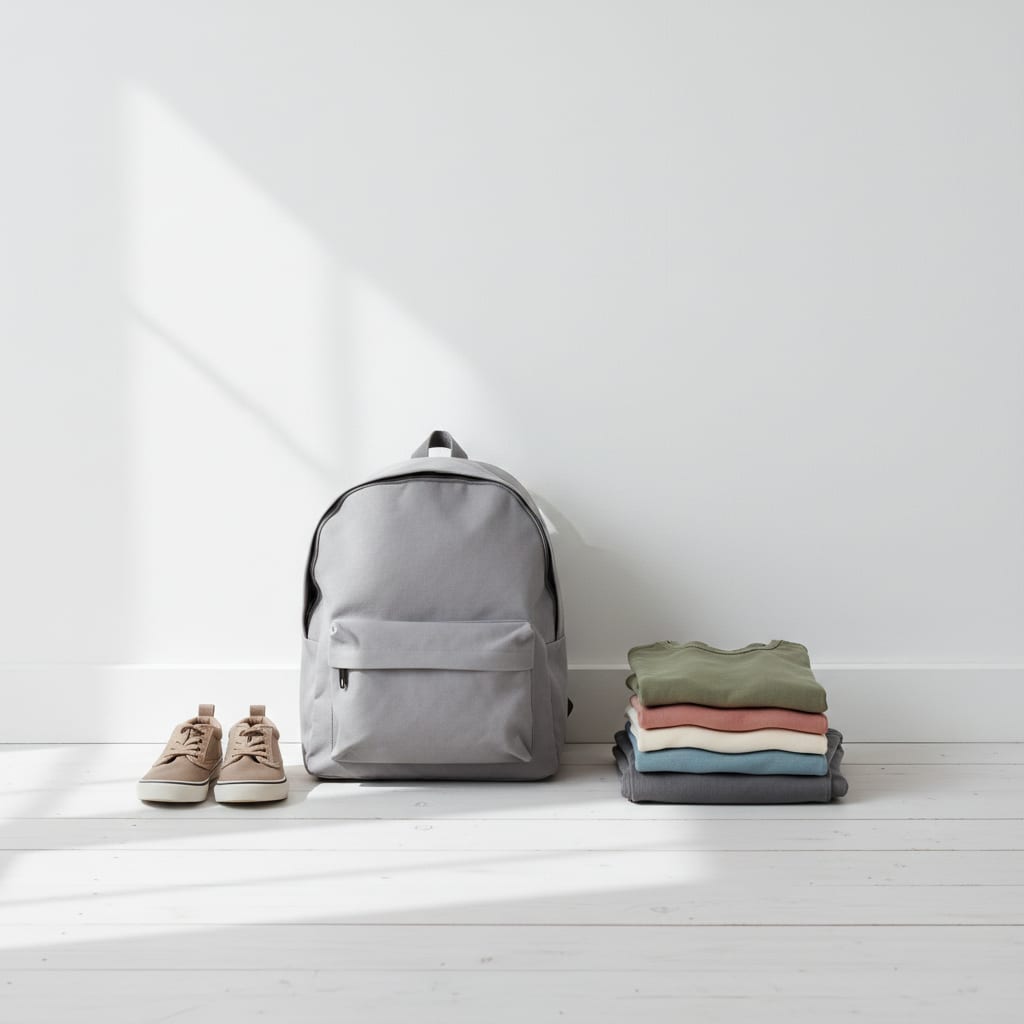
A back-to-school capsule is 15 pieces of outerwear-to-shoes clothing per kid: 5 tops, 4 bottoms, 2 layers, 1 jacket, 1 dressier outfit, and 2 pairs of shoes. Socks, underwear and pajamas sit outside the count as consumables. Fifteen covers a five-day week with a full laundry cycle of margin, fits in one drawer plus a few hangers, and — the part you feel at 7:40 a.m. — makes every option in the drawer a working option, because nothing in there is too small, too scratchy, or waiting on a missing half.
The 15, and why each number is that number
5 tops. One per school day. Five is the smallest number that survives a week when laundry happens on the weekend, and the largest number a kid will reliably rotate through instead of re-wearing the top one. If your school has a uniform, this becomes 5 uniform tops and the rest of the list barely changes.
4 bottoms. Bottoms get a second wear far more often than tops, so four covers five days honestly. Mine is two pairs of pants, one pair of shorts or a skirt, one pair of leggings or joggers — hedged for the fact that September is summer and October is not.
2 layers. A zip hoodie and a cardigan or fleece. Classrooms are either arctic or tropical, never the temperature the forecast implied, and a layer is what lets one set of tops work across a 25-degree swing.
1 jacket. One for the current season. The heavy coat is a seasonal swap-in, not a fifteenth piece competing for drawer space in August.
1 dressier outfit. Picture day, a concert, someone’s grandmother visiting. One. The failure mode here is buying the nice thing in September and discovering in May that it never fit past Christmas.
2 pairs of shoes. One everyday sneaker, one weather or gym pair. That’s it — and this is where most kids’ closets carry four pairs, three of which are outgrown or hated.
That’s 15. The full kids’ capsule wardrobe counts run slightly higher because they cover the whole year rather than a school term; this is the school-week subset, and it’s the one that decides your mornings.
Shop your own house first
The single biggest mistake in late July is starting at a store. Before anything: pull every piece of clothing your kid owns, have them try on the ambiguous items — the ones you think still fit — and sort into keeps, outgrown, and the maybe pile that goes back in the drawer for one more try-on in October.
You will almost always finish this with 11 or 12 of the 15 already in hand. The list you take shopping is then three or four specific items, which is a completely different errand than “back-to-school shopping,” an activity designed by people like my former self to be open-ended. I spent years as a retail buyer for a big-box chain, and back-to-school was our second Christmas precisely because parents arrived without a number. A list with a number in it is immune to an endcap.
Once the gaps are named, the printable capsule checklist is the version to take with you — or a photo of the drawer on your phone, which prevents the classic purchase of a fifth navy shirt.
The two pieces worth buying properly
Thirteen of the fifteen can be hand-me-downs, last year’s survivors, or whatever’s decent and cheap, because kids outgrow clothing faster than they can destroy it. Two exceptions earn real money, because they’re used every single day and failure is loud.
The everyday sneaker. Worn 180 days a year, through gym, recess and the walk home. The buy-right move is one well-constructed pair in a boring colorway your kid actually chose — a classic like the New Balance Kids’ 574 is the canonical version of this: supportive, unremarkable, goes with everything in a capsule, and survives to the next kid if you’re lucky with sizes. Buy one pair, not two, and replace when outgrown rather than when bored.
The backpack. The one item carried every day for years, and the one most likely to be replaced annually for reasons that have nothing to do with wear. Buy the durable plain one once — the JanSport SuperBreak One is the reference point here for a reason: one main compartment, a front pocket, a warranty, and no character licensing that expires emotionally in March. A plain bag that lasts four years is cheaper and calmer than four themed bags.
Everything else — the tops, the bottoms, the layers — should cost what it costs. The whole logic of buying less and buying right is that concentrating your money on the two items that get daily use is what makes the other thirteen unimportant.
Set up the drawer so mornings run themselves
A capsule that lives in a pile is just a smaller pile. Two arrangements do most of the work:
- Everything in one drawer, folded upright. Tops in front, bottoms behind, layers on the hanging rail. A six-year-old can dress themselves from a drawer where every item is visible edge-on; they cannot from a stack where they have to excavate.
- Shoes by the door, in a spot that holds exactly two pairs. A shoe spot with a fixed capacity is a keep-count you never have to enforce, because the third pair has nowhere to go.
For the closet mechanics — bin sizing, rail heights, what to do with the off-season box — Retro Modern Mom’s kids’ closet organization guide is the practical one, and organizing is genuinely her lane. This page’s job is the number.
Holding the 15 through October
Back-to-school capsules don’t fail in August. They fail in the six weeks afterward, when a grandparent sends two shirts, a birthday brings a hoodie, and the school fundraiser produces a spirit tee nobody asked for.
The rule is boring and it works: one in, one out, applied to clothes. A new top arrives, an old top leaves the drawer that day — the kid picks which. It takes ninety seconds and it converts a gift from a storage problem into a straight swap. Nothing about the count changes, so nothing about the mornings changes either.
The one seasonal exception is the actual weather change. Around the first genuinely cold week, swap the shorts for pants and the jacket for the coat as a single deliberate event, and box the outgoing set. That’s a swap, not an addition, and it’s the only time in the school year the drawer’s contents should change wholesale.
FAQ: the back-to-school capsule
Is 15 pieces enough if we do laundry once a week?
Yes — that’s what it’s sized for. Five tops and four bottoms cover a five-day week with the weekend as the wash window. If laundry slips to every ten days in your house, add two tops rather than expanding every category; tops are the constraint, not bottoms.
What about socks, underwear and pajamas?
They sit outside the 15 because they’re consumables that get lost, stained and outgrown on their own schedule. A workable count is 10 pairs of socks, 10 pairs of underwear and 2 sets of pajamas per kid — enough that a missing sock is never a crisis.
My kid wants to pick everything themselves. Does the capsule survive that?
It survives better, actually. Set the count first, then hand over the choosing: “we’re getting four bottoms — which four?” Kids defend a wardrobe they picked and fight one imposed on them. The number is yours; the taste is theirs.
How do I handle school uniforms with this?
Uniforms simplify it: 5 uniform tops, 3 uniform bottoms, 1 layer, plus a small weekend set of about 4 tops and 3 bottoms. The total lands close to the same 15, and the morning decision disappears entirely, which is the whole point of a uniform and half the point of a capsule.