№ 16
The Minimalist Mom Life: What It Looks Like (For Real)
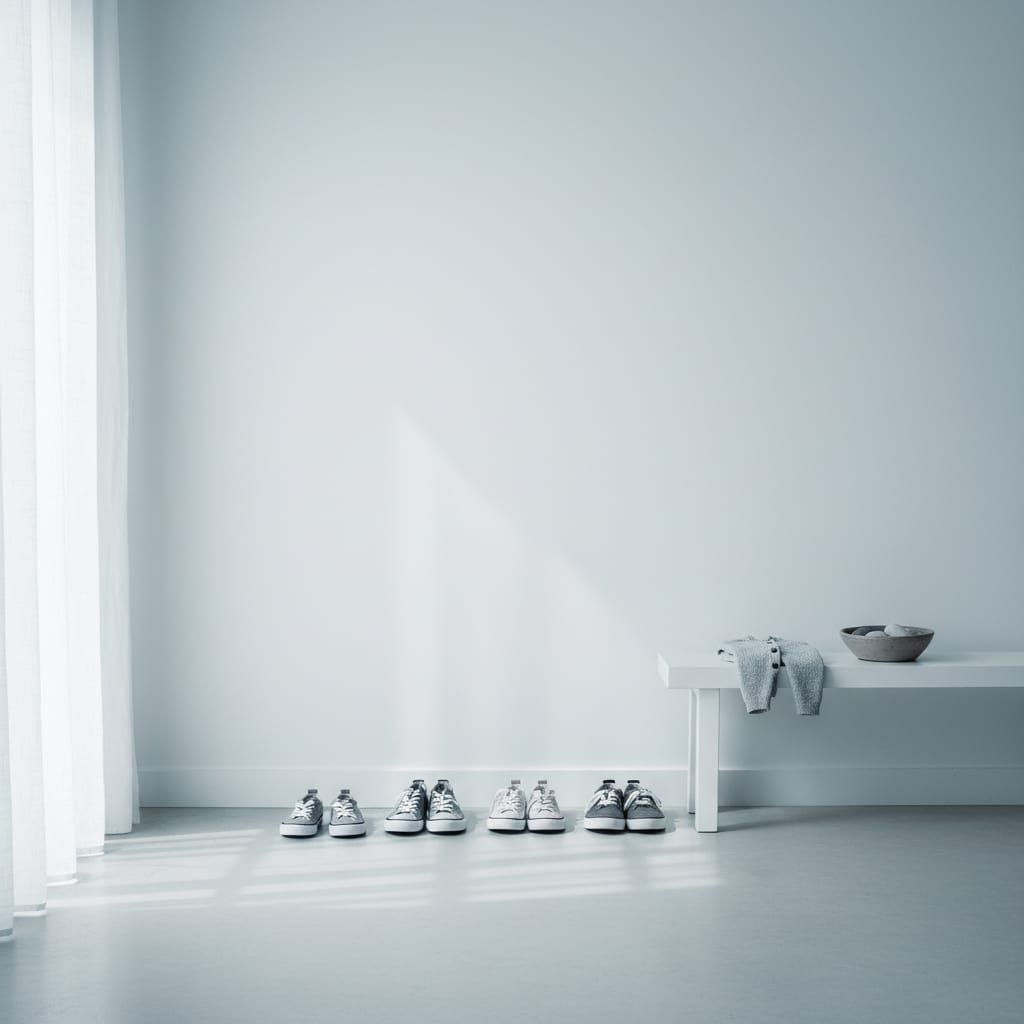
Minimalist mom life is not a white room with four wooden toys in it. In practice it’s three habits: a keep-count for every category that tends to multiply, a rule that caps what comes in, and a house where every object has a home with air left over. What that buys you is ordinary and enormous — cleanup measured in minutes, a floor you can cross barefoot at night, and shopping decisions that take five seconds because the number already answered them. The aesthetic is optional. The counts are the thing.
What our house actually looks like on a Tuesday
There are shoes by the door — four pairs, because there are four people. There’s a shelf of toys in the living room that holds what it holds, with visible gaps. There is a bowl on the counter with somebody’s rock collection in it. The couch has a blanket on it that does not match anything.
There is also, right now, a half-built cardboard structure occupying a third of the dining room, because a six-year-old is in a construction phase and that’s a fair use of floor space for a week.
I say this because the version of minimalism that circulates in photographs is a styling job, and comparing your Tuesday to it is a losing game. A real minimalist house with kids reads as uncrowded, not empty. You notice it as an absence of friction rather than a presence of design.
The three habits, in order of how much they matter
1. Slow the inflow. This is 70% of the result and the part almost everyone skips. Stuff enters a house with kids at a rate that no amount of clearing out can outpace — gifts, freebies, hand-me-down bags, the impulse buy that costs $6 and lives for eleven years. I spent years as a retail buyer for a big-box chain, which means I spent years professionally studying the inflow, and I can tell you the industry has never once worried about your January purge. It worries about your March. Change what arrives and the whole problem changes shape. That order — inflow, then counts, then clear-out — is the whole method, laid out in minimalism with kids.
2. Set counts, not moods. “Less” is a feeling and feelings drift. A number doesn’t. Ours: a toy shelf that closes the argument by being full, drawers that shut without pressure, one bookcase, four pairs of shoes each. Yours will be different numbers and that is completely fine — what matters is that the shelf decides, not your patience on a given evening.
3. Cap the total. One in, one out, permanently, including December. This is the habit that turns a good month into a different house, and it’s the one that runs on autopilot once kids accept it as physics rather than punishment.
What a minimalist mom still owns
Plenty. This is where the label misleads people, so let me be concrete about what has not been minimized here:
- Books. One bookcase, but a full one, and it turns over constantly through the library.
- Art supplies. Generously stocked, because they get consumed. Things that get used up don’t accumulate; they’re the opposite of clutter.
- Sports and outdoor gear. Bulky, unphotogenic, entirely earning its keep.
- A few genuinely sentimental objects per kid. One box each. Not zero — zero is a doctrine, not a life.
- Duplicates of the things that fail at the worst moment. Two pairs of kid scissors. A spare phone charger. Minimalism that creates a household emergency is just bad inventory management.
What has been minimized is the middle tier: the stuff that’s fine, that nobody chose, that arrived, and that nobody would notice leaving. In most houses that tier is the majority of the objects, and it’s where the entire weight comes from.
The part nobody photographs
Three honest costs, since a page about this ought to name them.
It requires deciding, repeatedly. Owning less means the same object comes back to you as a question — keep, pass on, replace — instead of being absorbed silently into a bin. That’s less physical work and slightly more thinking.
You will occasionally be wrong. We passed on a scooter that would have been perfect a year later. Cost: one scooter. This is the whole risk and it is survivable.
Nobody else in your house signed up. A partner, a grandparent, a kid mid-collection phase — none of them are obligated to your system. The workable move is to run it on your own domains, let the calm be visible, and never once make it a moral argument. Nobody in the history of houses has joined minimalism because they lost a debate about it.
Where the money goes instead
The part that surprises people: minimalist mom life is not the same as spending less on everything. It’s spending less on more things and more on the few that get daily use. When you own one everyday sneaker instead of three, the one gets to be good. When you own one water bottle per kid, it can be the one that survives a school year.
That’s the whole buy less, buy right trade, and it’s why this site names one canonical pick per category rather than a fifteen-item roundup. Fewer decisions, each one weightier.
How you know it’s working
Not by how the room photographs. By these:
- Cleanup before dinner takes under ten minutes and doesn’t require you.
- Your kid can find the thing they want without asking you where it is.
- You can name, roughly, how many of each big category you own.
- A gift arriving is mildly pleasant rather than a logistics event.
- You’ve stopped doing the periodic overhaul, because there’s nothing to overhaul.
That last one is the real finish line. The overhaul is a symptom of an uncapped house; once the cap holds, the big purge simply stops recurring. If you want to see the full mechanics of the cap — including what to do with the out-pile and how to run it without tears — it’s all in the one-in, one-out toy rule, which generalizes to clothes and books without modification.
And to be clear about the tone this site will never take: there is no judgment here of the house with ninety toys in it. I helped stock that house professionally and some of my favorite people live happily inside one. This is for the parents who suspect the stuff has quietly taken over the evenings, and want a calm, numerical way to take them back.
FAQ: minimalist mom life
Do I have to get rid of sentimental things?
No. Give each kid one box with a fixed size and let the box be the rule — when it’s full, something leaves to make room. A fixed container does the deciding without asking you to justify a keepsake, which is a conversation nobody wins.
Does minimalism work with more than one kid?
Yes, and it gets more useful, not less, because shared spaces are where crowding shows up first. The counts are per-category rather than per-child for shared things — one toy shelf for the family room, not one per kid — and per-child only for clothes and personal boxes.
How is this different from just decluttering?
Decluttering is an event; this is a rate. A clear-out empties the house once, and without an inflow cap it refills on the same schedule it always did. The counts and the one-in-one-out rule are what make the clear-out a one-time job instead of an annual one.
What if I start and my kids hate it?
Expect about a week of protest and then very little. Kids object to things disappearing without them, not to a rule that applies evenly. Involve them in choosing what stays, keep the count visible, and let the shelf — not you — be the thing saying no.