№ 15
KonMari With Kids: What Works, What to Skip
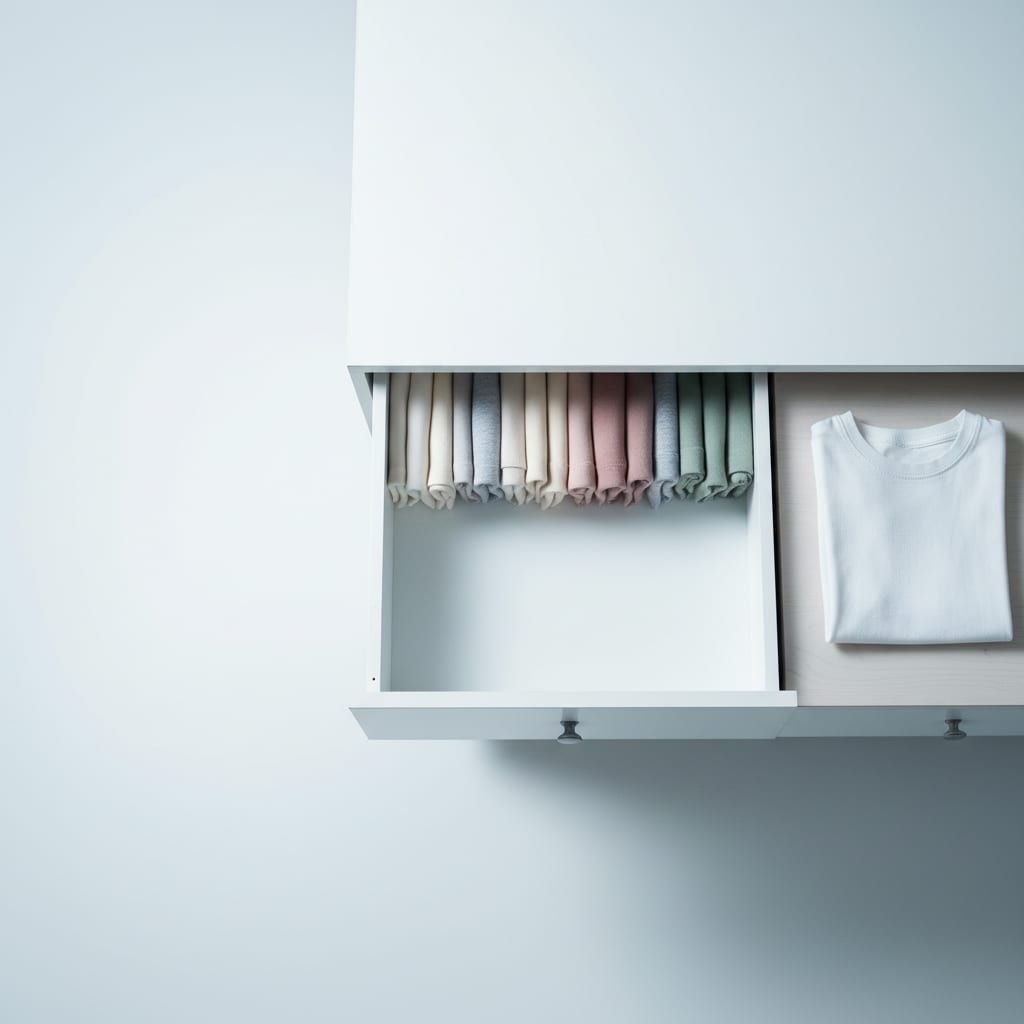
KonMari works with kids in two of its parts and struggles in the rest. What holds up: tidying by category instead of by room, and the vertical folding that makes a drawer readable. What doesn’t survive a house with a three-year-old in it: the marathon “one-shot” timeline, the strict category order that saves sentimental items for last, and “does it spark joy” as a screening question for a child who feels joy about a bottle cap. Take the two structural ideas, replace the emotional test with a count, and the method becomes genuinely useful.
A quick, fair summary of the method
Marie Kondo’s The Life-Changing Magic of Tidying Up proposes that you tidy once, thoroughly, by category rather than location — clothes, then books, then papers, then miscellany, then sentimental items — gathering every item in a category into one pile, handling each one, and keeping only what sparks joy. Everything kept gets a designated home, and the claim is that a properly finished tidying event doesn’t recur.
It’s a coherent system and it made an enormous number of houses better. It was also written for adults tidying their own possessions, and the difference matters more than any single tactic in it.
What works, kept as-is
Tidying by category. This is the strongest idea in the book and it survives kids completely. Gathering every pair of pants in the house into one pile is what reveals that you own fourteen and use six — a fact no room-by-room pass will ever surface, because the surplus is distributed. Do this with kids’ clothes and you will find the count is roughly double what anyone guessed. It’s exactly how the kids’ capsule wardrobe counts get set: pile first, then number.
The vertical fold. Folding so items stand on edge in a drawer rather than stacking is not a lifestyle claim, it’s a visibility fix. Every item is its own spine on a shelf. The practical payoff in a kid’s room is that a six-year-old can dress themselves, because they can see what’s there without excavating; and a drawer where nothing is buried stays tidy for weeks instead of days.
“Everything gets a home.” Unglamorous and correct. The reason a house re-clutters is that a percentage of objects have nowhere specific to go, so they land on surfaces. Assigning homes is what makes a five-minute reset possible.
What to skip, and what to run instead
Skip the one-shot marathon. The method’s timeline assumes uninterrupted stretches and an endpoint. Kids supply neither: they generate new inflow continuously, they outgrow entire categories twice a year, and they will need lunch in the middle of your papers pile. Running it as a single heroic event mostly produces an abandoned pile in a bedroom.
Instead: one category per weekend, at whatever pace holds. The finish line isn’t “done forever,” it’s “capped” — see your first 30 days of family minimalism for a sequence built around that assumption.
Skip “does it spark joy” as the kid-facing test. For adults it’s a genuinely clever prompt — it replaces a logical question you can rationalize with an instinctive one you can’t. For children it fails, because a four-year-old’s honest answer about a broken party-favor whistle is yes, enthusiastically, and they are not lying.
Instead: use the count as the test. “The shelf holds ten toys. Which ten earn their place?” This preserves everything good about involving the child — agency, fairness, no things vanishing overnight — while giving them a constraint they can actually reason inside. Working numbers by age are in how many toys does a child actually need.
Skip the strict category order. KonMari saves sentimental items for last on the theory that you’ll have built decision-making stamina. Sound theory. But in a family house, the categories with the highest daily friction are toys and clothes, and momentum comes from fixing the thing that ruins your mornings. Start where the pain is; the sentimental box can stay closed for a year and cost you nothing.
Skip “the tidying event never recurs.” It recurs, because kids grow. Two swaps a year — outgrown clothes out, seasonal set in — is the permanent maintenance floor, and no method removes it. What can be removed is the annual overhaul, and that’s done with an inflow cap rather than a better purge.
The part KonMari genuinely doesn’t cover
The method is about what you already own. It has almost nothing to say about the rate at which new things arrive, which in a house with kids is the entire problem.
I spent years as a retail buyer for a big-box chain, and I’ll tell you plainly: the household tidying event was never a threat to anyone’s forecast. We knew the shelf would clear in January and we knew the birthday aisle, the checkout display and the grandparent gift budget would refill it well before summer. Nothing in a tidying method touches that mechanism.
So whatever you take from KonMari, pair it with a cap: one in, one out, applied at the moment of arrival. That’s the piece that makes a tidying event a one-time job instead of an annual ritual — the full mechanics are here, and they generalize from toys to clothes and books unchanged.
The honest verdict
Read the book if you like the philosophy — it’s short, it’s calm, and the folding chapter alone changes drawers. Then use maybe 40% of it: category-based tidying, vertical folding, homes for everything. Replace the joy test with counts, replace the marathon with a slow cadence, and add the inflow rule that the method doesn’t include.
For the physical mechanics of an actual clear-out session — what order to work a room, where to stage the donate pile, how to keep the outgoing box out of small sightlines — Retro Modern Mom’s declutter checklist is the practical companion, and she’s better on that than any method book. She’s run the same fair-minded look at the FlyLady method, which pairs interestingly with this one: both are systems built before the current volume of kid stuff existed, and both still have parts worth keeping.
FAQ: KonMari with kids
Can you do KonMari with a toddler in the house?
You can do the category-and-folding parts of it. You cannot do the timeline. Work in single categories during naps or weekends, accept that it’ll take a season rather than a weekend, and don’t gather the whole house into one pile with a toddler mobile — pile one category at a time, in a room with a door.
Should kids KonMari their own toys?
They should participate, but with a count rather than the joy question. “Pick the ten that stay” is a decision a young child can make and defend. “Does this spark joy?” returns a yes for essentially every object, which teaches nothing and ends with the same shelf you started with.
Does the folding method actually last with kids?
Better than stacking does, in my house. Upright folding survives because putting a shirt back correctly is a one-second motion with a visible slot, whereas restacking requires lifting a pile. It won’t stay gallery-perfect; it will stay readable, which is the part that matters at 7:40 a.m.
What about school papers and kids’ artwork?
That’s genuinely its own system and it doesn’t fit inside a tidying category — the volume is weekly and the emotional weight is uneven. Run a dedicated keep-toss rule for it; Retro Modern Mom’s school papers system is the one we use rather than folding it into a general pass.