№ 30
Bunk Bed Safety: The Age Rule and the First Two Weeks
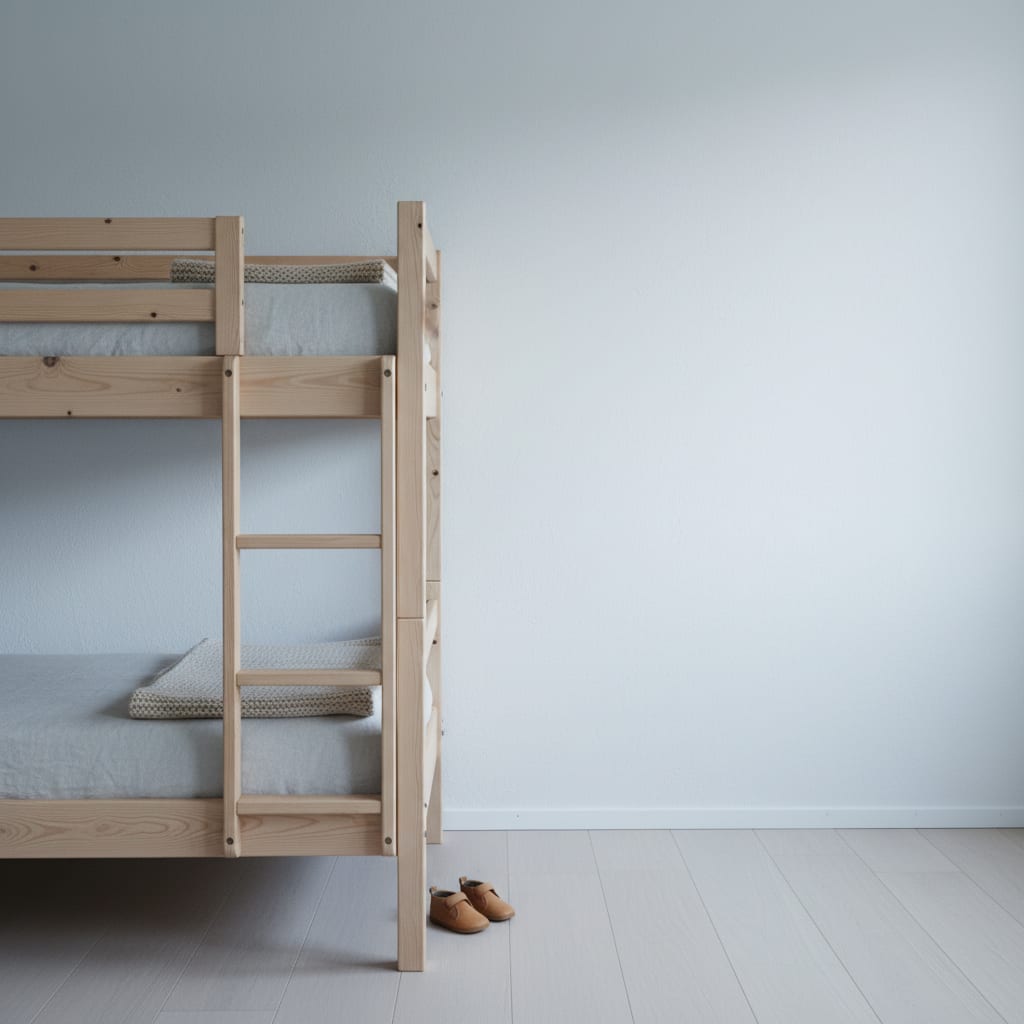
No child under six sleeps on the top bunk. That’s the line the American Academy of Pediatrics draws, and the one the federal bunk bed standard requires on the warning label bolted to the frame. It’s about coordination on a ladder in the dark, not maturity. Underneath it sit three measurements: guardrails on both sides of the top bunk, their upper edge at least five inches above the mattress, and no gap anywhere wider than three and a half inches. Get those right and the rest is two ordinary weeks.
The measurements that decide it
All of it is published, not inferred.
| Check | Number | Source |
|---|---|---|
| Age for the top bunk | 6 or older | AAP, and the required label |
| Guardrails up top | Two, one per side, once the foundation sits over 30 in. off the floor | 16 CFR 1513 |
| Guardrail height | Upper edge 5 in. or more above the mattress | 16 CFR 1513 |
| Any gap a child could slip through | 3.5 in. or narrower | Nationwide Children’s |
Two of those get measured wrong in ordinary houses.
The five inches is measured from your mattress, not the listing photo. Federal testing assumes the thickest mattress the maker permits, so a topper or thick waterproof pad raises the sleeping surface and shrinks the rail. Under five inches means a thinner mattress, not a taller child.
The three and a half inches is measured with weight on the bed. A mattress compresses, and the gap under the rail opens up when a child is lying there. That’s a head-entrapment dimension, not a rolling-off one. Press down and look again.
Four more things that cost nothing: a ladder attached to the frame rather than hooked over it, a night-light where the ladder meets the floor, the bed in a corner so two of its four sides are wall, and nothing overhead — a ceiling fan above a top bunk is bad geometry.
Why it’s worth the afternoon: a 2008 study in Pediatrics from Nationwide Children’s Hospital’s Center for Injury Research and Policy counted roughly 572,580 bunk-bed injuries treated in US emergency departments between 1990 and 2005 — about 36,000 a year — and found around half of the children hurt were younger than six. In the release announcing the federal standard in 2000, the CPSC put entrapment deaths at an estimated ten children a year, 57 reported since 1990. Old figures, and the standard exists because of them — read them as the reason for the rules, not as today’s odds.
Why six, and what to do with a five-year-old
The age line isn’t about whether your child is sensible. It’s one physical task: descending a near-vertical ladder, half asleep, in the dark, needing the bathroom. Younger children are top-heavy, which is why the injuries in that study clustered on heads and faces — a small body that loses the rungs goes down head first.
So a five-year-old sleeps on the bottom. There’s no published age rule for the lower bunk — the published rules are all about the top one, and the lower bunk is a low bed with a ceiling. Ours slept there eighteen months before swapping, and the swap was uneventful because it had been promised as a birthday rather than won as a battle.
If the bed is being bought to end a different problem — a child climbing out, a crib outgrown — that’s the earlier move out of the crib, and a bunk isn’t the answer to it at three.
What a bunk bed is actually for
I spent years as a retail buyer deciding which objects earned shelf space, and a bunk bed is unusual in that world: it subtracts. A room that held two frames and no play space holds one frame and an empty middle. That’s the whole case, and it’s the same case as buy less, buy right — the purchase that removes more than it adds.
It also behaves oddly on a P&L. A bunk is bought once, doesn’t restock, and nobody builds a seasonal campaign around it — which is why the frames tend to be honest and the accessories are where the margin lives. Tent kit, slide, curtain set, under-bunk drawers, themed panels. Each is sold against the excitement of the move, and each is still there when the excitement isn’t.
So buy the plain one. Max & Lily’s solid-pine twin-over-twin is the shape I’d point at: real wood rather than veneered particleboard, a ladder built into the frame, guardrails on both sides, no theme to outgrow, and it splits into two twin beds later — the buy-it-once test doing its job across the shared room and then the separate ones. Whatever you buy, measure the guardrail against your own mattress and pad before anyone sleeps up there. That number is yours to check, not the box’s to promise.
Storage doesn’t need buying: under-bunk drawers and over-rail organisers are the endcap, and the mechanics of a shared room belong to Retro Modern Mom’s shared kids’ room organization.
The first two weeks, honestly
Assembly day is the easy part. The fortnight after it is where families get surprised.
Nights one to three are usually great. Novelty does the work. Don’t read it as a verdict.
Nights four to ten are where the wobble lands. Bedtime stretches, a child who has slept alone for years appears at your door, or the one on the bottom announces the top is theirs. Nothing has gone wrong; the room changed and the settling has to be relearned. If your younger one is still in the clinginess-at-bedtime years, expect some of it back for a week or so.
Practise the ladder in daylight, twice. Up, down, then down again with the light off and the night-light on. Four minutes, and it’s what most protects the 2am descent.
Cap what goes up there on day one. A top bunk is a shelf a child sleeps on, and it fills. Ours runs the house count — two soft toys in the bed, the rest on the shelf below, per how many stuffed animals — plus a sheet and one blanket, nothing hard. No cups, no torches, no books against the rail. Things fall from a top bunk, and someone is underneath.
Nothing gets tied to the frame. No belts, scarves, skipping ropes or dressing-gown cords, ever. That’s a strangulation route, and it’s on every safety list for a reason.
Say the no-play rule once, out loud. The bunk is for sleeping — not a fort, not a launch pad. Said on day one it holds; said after the first jump it’s a negotiation.
By about day fourteen the bed stops being an event and becomes furniture, which is the outcome you want. That’s minimalism with kids in miniature: the exciting version of a thing is temporary, the useful version is what you’re paying for.
FAQ: bunk beds, age and safety
At what age can a child sleep on the top bunk?
Six, at the earliest. The AAP says not to let a child younger than six sleep in the top bunk, and the federal standard requires that warning on the bed itself. It’s a coordination threshold, not a maturity one, so it isn’t a line a particularly careful five-year-old talks you past.
Are bunk beds safe for a 4-year-old on the bottom?
The published rules are all about the upper bunk; there’s no equivalent age line for the lower one, which is a low bed with a frame overhead. What matters at four is that the top bunk’s foundation is properly supported by slats or wires fastened at both ends, and that the ladder isn’t treated as a climbing frame.
Do you need guardrails on both sides if the bed is against a wall?
Yes. The federal standard requires a rail on each side once the underside of the foundation is more than 30 inches off the floor, wall or no wall — and the wall-side rail has to run continuously, because the gap that opens between a mattress and a wall is exactly the space a child slips into.
Is a second-hand bunk bed a bad idea?
Not automatically, but check the date: the federal standard has been mandatory for beds made or imported for US sale since July 2000, so anything older predates it. Take it only with its full hardware and instructions — guardrails and foundations are not parts to improvise — and skip it if any rail, rung or fastener is cracked or missing.