№ 32
The Kids' Bedroom Furniture List: What You Actually Need
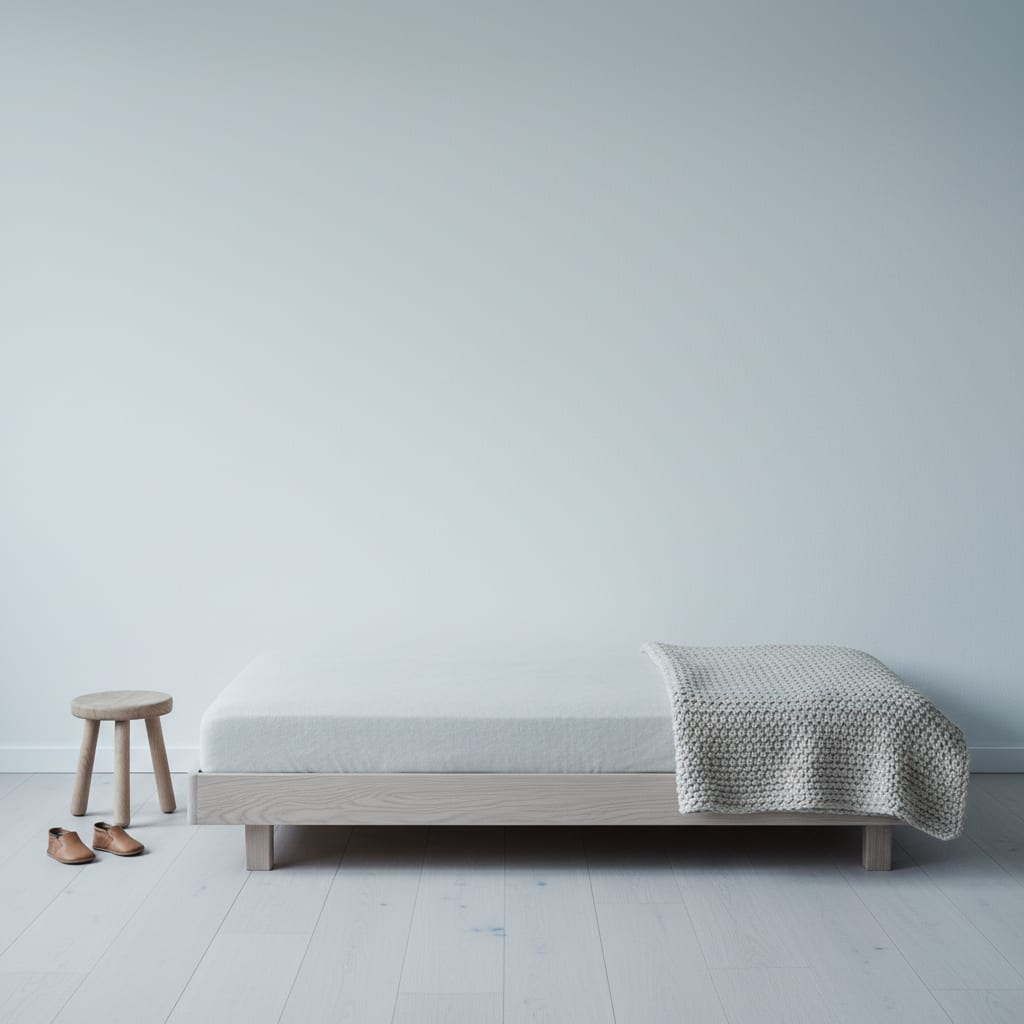
A kid’s bedroom needs five things: somewhere to sleep, somewhere for clothes, a light they can reach, one low surface, and a floor worth sitting on. That’s the furniture list. Everything else in the catalogue photograph — the themed headboard, the toy chest, the desk bought at five for homework that arrives at nine — is a second sale dressed as a starter kit. Buy the five, anchor anything tall to the wall the day it arrives, and let the room stay half empty for a while. Rooms fill on their own.
The five pieces, and the honest version of each
| Piece | What it has to do | The honest version |
|---|---|---|
| A bed | Hold a sleeping child, fit the room, last a decade | A low frame with a slatted base; no built-in storage |
| Clothes storage | Hold one season at a time | Three or four drawers, anchored — not six |
| A light they control | Come on without an adult | One dim lamp or plug-in they can reach from the bed |
| One low surface | Take a cup, a lamp, a hand at 2am | A small stool or crate, knee height |
| A soft floor | Be the actual play surface | A washable rug, or nothing if the floor is warm |
Two of those need arguing for, because the catalogue disagrees.
Clothes storage should be smaller than you think. The drawers set the wardrobe, not the other way round: a six-drawer dresser will be full within a year of buying it, whatever your intentions, because empty drawers are the most persuasive shopping list ever invented. Size the storage to the count you actually want — how many clothes kids need has the working numbers — and the drawers do the enforcing for you.
The low surface matters more than the desk. Small children need somewhere to put a cup of water and something to hold while getting out of bed in the dark. A small wooden stool does that job for fifteen years. A desk at four does not get used for schoolwork; it gets used as a shelf, and then as a shelf you have to clear.
Anchor it before you fill it
This is the one part of a furniture list that is not a preference.
Tall furniture tips. The federal standard for dressers and other clothing storage units — the one the STURDY Act required — took effect on 1 September 2023, and the CPSC’s own summary states the case for it plainly: 234 fatalities from clothing-storage-unit tip-overs between January 2000 and April 2022, 199 of them children, plus an estimated 84,100 tip-over injuries treated in US emergency departments from 2006 through 2021. The tests behind the standard simulate a child of up to 60 pounds pulling on open drawers, on carpet.
Two practical readings of that. First, a dresser made to the current standard is meaningfully steadier than the one in your parents’ garage — which is the single strongest argument for buying this one piece new. Second, the standard is not a substitute for a strap. Anchor anything taller than it is wide, plus anything a child can climb, on the day it comes into the room, before a single item goes in the drawers. Safety 1st’s furniture wall straps are the plain canvas-and-screw kind and cost less than a takeaway; buy the multipack and do the whole house in one afternoon. If a piece is rented or the wall is unsuitable, the alternative is a shorter piece, not a hopeful one.
While you have the screwdriver out: put the bed away from the window blind, and cut or secure any blind cord in the room.
What the catalogue adds, and why
I spent years as a retail buyer deciding which objects deserved shelf space, and children’s furniture is a category built on one insight: the room is bought in a single emotional afternoon, usually before the child is old enough to have an opinion. So the range is assembled to be bought as a set. The bed anchors the price, and the matching nightstand, toy box, bookcase, hamper and wall shelf are each a small yes after a big one, when saying no has stopped feeling like saving money and started feeling like spoiling the room.
The pieces I’d leave in the shop, and what happens instead:
- The toy chest. A deep lidded box is where toys go to be forgotten, and lids are a pinch hazard. The toys live where they’re played with, capped at a number — see how many toys a child actually needs.
- The matching bookcase. One low shelf holds more books than a child reads in a season, and the count matters more than the furniture.
- The themed headboard. Priced against a character your child will renounce, publicly, at seven.
- The desk, before about eight. Homework happens at the kitchen table, next to an adult, for years longer than the furniture range assumes.
- The under-bed storage system. Bins and organising systems are their own craft, and they belong to Retro Modern Mom’s kids’ closet organization, not to a furniture list.
The test I use is the buy-it-once one: will this piece still be doing a job in ten years, or is it doing a job that only exists for eighteen months? Beds and drawers pass. Almost nothing else in the set does.
Buying order, and where second-hand wins
Buy in this order: bed, then drawers, then light, then the surface, then the rug. Live with each for a fortnight before adding the next. Rooms that get furnished in one delivery contain roughly two pieces nobody wanted.
Second-hand is excellent for bed frames — a solid wood frame is a plain object with no failure mode, and it’s usually half price. Be more careful with dressers, for the reason above, and skip anything with a broken slat, a missing fastener or a rail you can’t source parts for. If the bed in question is a bunk, the numbers are not optional, and they’re in bunk bed safety.
One thing that isn’t furniture but changes the room more than any of it: a child who has just moved into a new bed doesn’t need a bigger pillow yet. Betteroo’s guide to when a pillow actually belongs in the bed covers the timing better than any furniture range will.
FAQ: kids’ bedroom furniture
What furniture does a child’s bedroom actually need?
A bed, somewhere to keep one season of clothes, a light the child can switch on themselves, one low surface within reach of the bed, and a floor that’s comfortable to sit on. Five pieces. A room with those is finished; a room with those plus a rotating cast of accessories is a room that will be re-bought in three years.
Should I buy a toddler bed or go straight to a twin?
Go straight to a twin if the room takes one. A toddler bed uses the crib mattress and buys you about eighteen months for the price of a piece of furniture with a fixed expiry date. The exceptions are a very small room, or a child who genuinely needs the lower height and the rails to feel safe — both real, and both worth the money when they’re true.
Is second-hand children’s furniture safe?
Bed frames, usually yes — check that every slat, bolt and rail is present and uncracked. Dressers, be choosier: the mandatory US stability standard for clothing storage units only took effect in September 2023, so older pieces were built to a voluntary one at best. Whatever the age of the piece, strap it to the wall.
How much storage does a kid’s room need?
Less than the room can hold. Storage capacity behaves like a budget — it gets spent. Set the clothing count first, buy drawers that just about hold it, and keep one shelf for books. If things genuinely don’t fit after that, the answer is usually a lower count rather than a bigger cupboard.