№ 40
Apartment Bedtime With Neighbors Below: What Helps
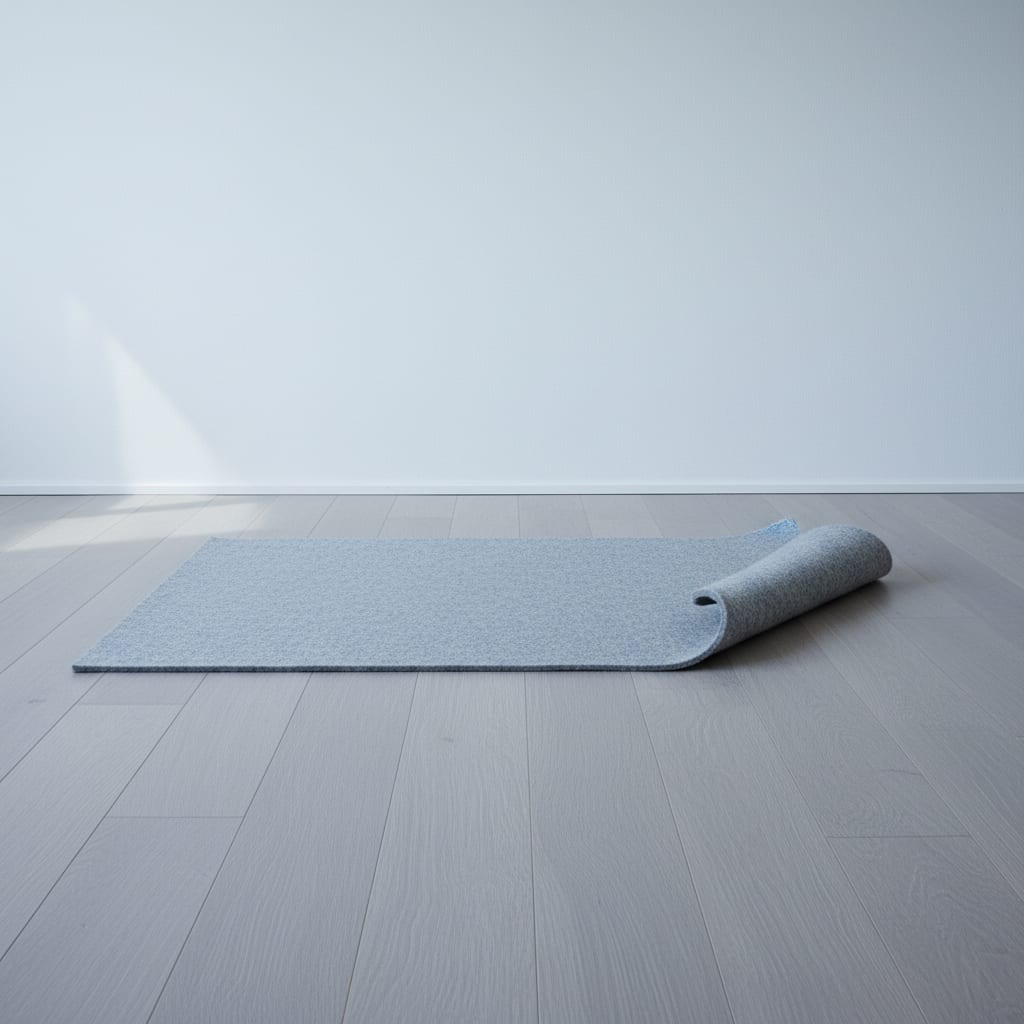
Bedtime got harder after the move because noise stopped being private. In a house an evening is loud or quiet and nobody grades it. In an apartment your sound goes down through the structure to somebody else’s ceiling, and theirs comes up through yours. Almost all of the fix is free: change where the loud part of the evening happens rather than making a child quieter, mask what arrives from below instead of blocking it, and treat the quiet hour as a fixed edge. One small purchase does the rest.
Two kinds of noise, and only one of them is yours
Impact noise is something striking the floor — heels on hard boards, a dropped cup, a four-year-old landing off the sofa. It travels through the building’s structure, which is why it arrives downstairs sounding close and undamped even when it wasn’t especially loud up here. This is the noise you send.
Airborne noise is voices, a television, a dog, the street. It travels through air and finds gaps — around doors, through vents, past a window. Mostly, this is the noise that arrives.
They need opposite treatments. Impact noise can only be dealt with at the source, before it enters the structure — in a rental, that means changing what happens on your floor. Airborne noise coming up can’t be blocked from your side at all, so the answer is to mask it. One shelf in the store sells against both, and that is where the money goes.
The noise you send down is about landings, not volume
The change that buys the most goodwill downstairs is never “be quieter.” It is finding the two or three places where a body meets the floor, and moving them.
Locate the landings. Off the bed, off the sofa arm, the sprint down the hallway, the ten minutes before bath when everyone goes feral. A conversation at normal volume isn’t one.
Move them earlier, onto one soft place. Telling a three-year-old to stop jumping fails by about Tuesday. Giving jumping a spot on a rug, before the quiet hour rather than after, works: you are relocating something that will happen anyway.
Take shoes off at the door. Adult hard soles on a hard floor are the loudest ordinary event in most apartments, and the one nobody counts because it isn’t the child’s.
What comes up you cannot fix, so mask it instead
Their television, their door, their dog, the bus. None of it is yours, none of it unreasonable, none of it blockable from inside your apartment.
Masking is a different strategy from blocking, and it’s the one that works. A steady, featureless sound raises the background level so a slammed door downstairs is no longer a change — and it’s the change that wakes a child, not the absolute volume. If you already run a sound machine you own the tool; it just matters more here than it did in the house. Cutting the routine down to its four load-bearing steps is still the first thing I’d do, and the machine is one of the four that survives.
Two rules: put it across the room, never on the crib rail or headboard, and set it low enough to hold a normal conversation over. Betteroo’s guide gives how loud a sound machine should be and where it should sit with the actual figures — worth reading once rather than guessing at.
If your child is under a year old, none of this changes the crib: flat, firm, bare, their own surface, on their back, machine on a shelf, nothing added inside the crib to help with noise.
And if the wake you’re chasing lands roughly forty minutes after lights-out, the waking that arrives forty minutes after lights-out is usually about the last wake window rather than the neighbors — worth ruling out before you rearrange the evening around a bus route.
The quiet hour is now an edge, not a preference
In a house, quiet hours are manners. In a building they’re usually written down — in the lease, the house rules, sometimes a local ordinance too — and they’re a constraint rather than a vibe. Read yours rather than assuming: buildings differ, cities differ, and a lease clause and a municipal rule can say different things.
What the edge changes isn’t your bedtime. It’s the order of the hour before it: loud things on the early side of the line, quiet things on the late side. That’s the adjustment. What time bedtime should sit is a question for someone who studies sleep, not a blog about cupboards.
One more free thing: tell the people below you once, early, without apologizing for having a child. “We’ve just moved in, we have a three-year-old, we keep the racket to before eight — tell me if something lands badly” buys more than any product on the market. Almost nobody is angry about a toddler. Plenty of people are angry about being surprised.
The one thing worth buying
A dense felt-and-rubber pad, under a rug you already own, where the landings happen. Be clear about what it does, because the category is oversold: it will not soundproof a floor, and nothing you can lay down yourself will. It cushions footfall before it enters the structure and stops the rug sliding when a child hits it at speed — and impact at the source is the only lever a tenant has.
The plain one is RUGPADUSA’s Dual Surface felt-and-rubber pad in the quarter-inch thickness, sized to the rug rather than the room. It does one job, rolls up, and is the same object in your next apartment. One right thing instead of a kit.
What the soundproofing aisle sells that won’t work here
I spent years deciding what earned shelf space in a big-box chain, and this problem is a merchandiser’s gift: urgent, nightly, tied to a fear of being complained about, and attached to no natural object. So objects get attached. Foam panels tame echo inside a room and do essentially nothing about sound passing through a floor assembly. “Acoustic” curtains soften a window slightly and cannot help with a ceiling, which is where your problem is. Peel-and-stick mats the thickness of a magazine are priced like insulation.
The test is the one this whole site runs on: does this remove a problem, or add an object to a small home? A pad under the rug removes. Everything on that list adds.
If bedtime was already hard before the move, the building isn't the whole story. Betteroo builds a personalized, day-by-day plan around your own child's wake windows, naps and bedtime — around $20 a month, and it's a timing tool rather than a miracle. Take the two-minute sleep quiz →A smaller place is a trade you chose
Some of the first few weeks is just the move — a new room, new light, a child checking whether the rules came with the furniture. That settles on its own. The structure doesn’t, and it has a second effect nobody mentions in the listing. In a house, the toy that has outstayed its welcome goes to the spare room, and the spare room is why the count never has to be decided. An apartment has none, so the count is the storage — how many toys a child actually needs stops being philosophical and becomes arithmetic about a specific closet. That isn’t a downgrade; it’s the building enforcing a limit the house let you avoid, which is most of what starting out with less looks like when it’s going well.
Name the cost honestly, though. You traded space for money, or a commute, or proximity to people you like — and for hearing a door at eleven. Both halves are true, and saying so beats performing contentment about the second.
FAQ: bedtime in an apartment
Will the neighbors complain about a baby crying? Very rarely, and almost never if they’ve met you. Crying is airborne and short; complaints come from repeated impact noise late at night — the half you can actually change.
Do soundproofing panels on the ceiling help? Not with this. Panels absorb echo within the room they’re in. Sound reaching you through a floor-ceiling assembly is a construction problem, not a surface one.
We’re on the top floor. Does any of this still apply? The half about noise you send down does. Masking matters less — though an interior or windowless room brings its own set of problems worth reading separately.
Is it fine to run white noise all night? Generally yes, at a low steady volume across the room rather than beside the bed. Volume and distance are the two things worth getting right; the guide linked above gives the specifics.