№ 28
How Many Stuffed Animals Does a Kid Need?
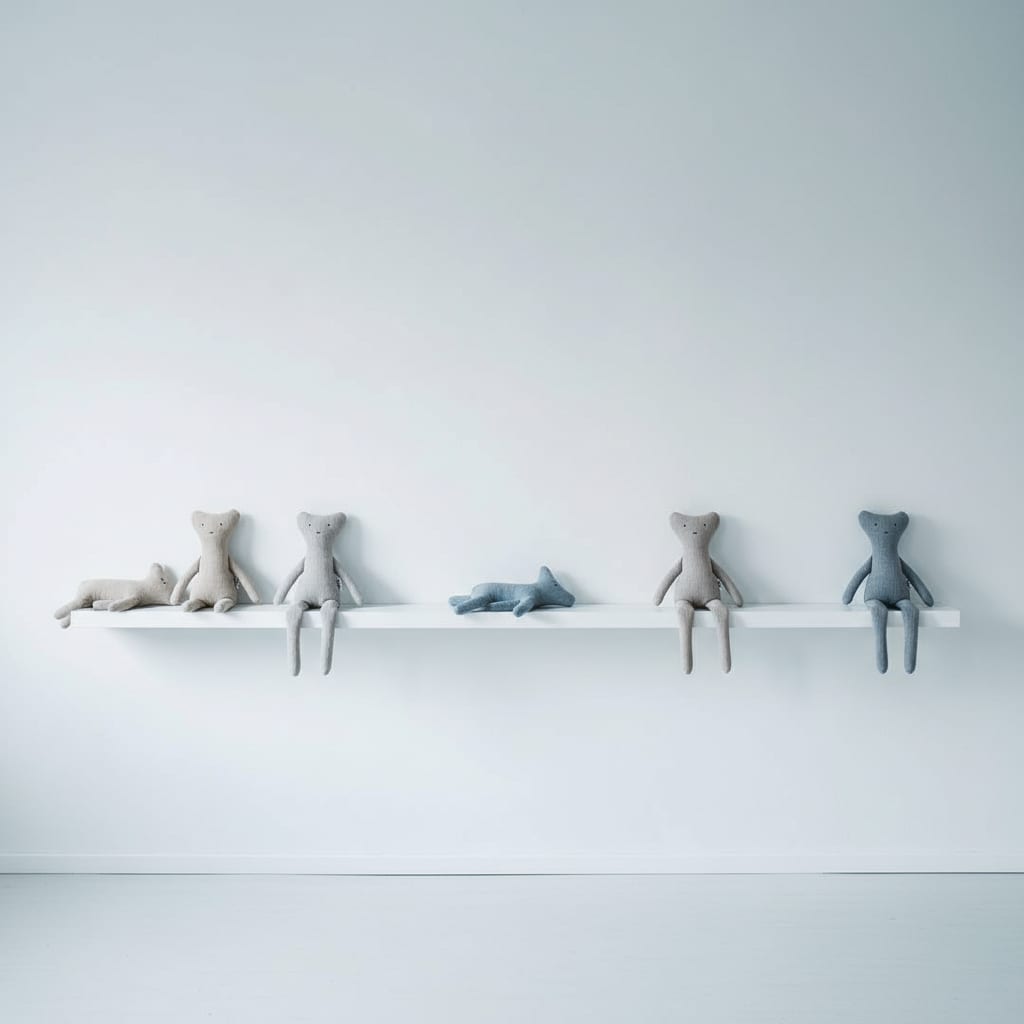
Five per kid living in the room, two of them in the bed, and one exempt favourite that no rule ever touches. Under twelve months the bed count is zero — nothing soft goes in the sleep space at all. Stuffed animals need a number of their own because they arrive faster than any other toy, they’re immune to the does-it-actually-do-anything test that thins a toy shelf, and they colonise the one surface in the house where volume genuinely costs you something: the mattress.
The cap, by age
| Age | Living in the room | Sleeping in the bed |
|---|---|---|
| Under 12 months | as many as you like, on a shelf | zero — the crib holds a mattress, a fitted sheet and the baby |
| 1–3 | about 3–5 | 1–2, chosen before pyjamas |
| 3–6 | about 5 | 2 |
| 6 and up | about 5, kid-curated | their call, from within the five |
These are working numbers, not findings — the household kind I use for toy keep-counts by age. Three notes make them hold.
Count them separately from toys. A plush pile doesn’t get “played with” in a way you can observe, so a use-based cull never reaches it. Give it its own number or it grows quietly underneath the number you’re already enforcing.
The exempt one is load-bearing. Every kid has the animal that is not an object — not counted, not rotated, not negotiated. Naming it explicitly is what makes the other five negotiable. A cap with no exemption gets fought; a cap with a named exception gets accepted in about a week.
The bed count is the one that changes anything. Room clutter is aesthetic. Bed volume is a nightly ceremony — the arranging, the falling-off, the who-sleeps-where — and it lengthens bedtime by however long you let it. If you want the wider picture of a house that’s over on toys generally, that’s the signs and the way back; this page is only the number.
The retire-or-keep test: four questions
Put the whole population in one heap — every animal in the house, car ones and closet ones included — and ask four things. Two yeses and it stays.
1. Does it have a name? The most reliable signal there is. A named animal is a character in your child’s world; an unnamed one is inventory that arrived at a birthday party. Kids answer this instantly and honestly, which is why it goes first.
2. Has it been chosen in the last month? Not “do you like it” — every answer to that is yes. Chosen: carried, slept with, packed, talked to, put in a game.
3. Does it survive a wash? A soft toy that can’t go through the machine and come out intact has a short future in a kid’s bed. Least sentimental question, and it retires more animals than the other three combined.
4. Would they notice it gone in three months? Nobody can answer that out loud, so don’t ask — put the maybes in a sealed, dated box, out of sight, and open it in three months. Almost nothing in ours has ever been asked for, and the one or two that are get returned with ceremony. That return is what makes the exercise read as fair rather than as a raid.
Run the survivors against the cap. If eight pass and the number is five, the kid picks the five — not you. They’re better at it than adults, because they aren’t sentimental about who gave it or what it cost.
Under one year, the bed count is zero
This is the one line on the page with no household flexibility in it. For the first twelve months a baby’s sleep space holds a firm, flat mattress, a fitted sheet made for it, and the baby. No stuffed animals, no loveys, no pillows, no bumpers, no loose blankets — the American Academy of Pediatrics is explicit that soft objects and loose bedding stay out of the sleep area for the whole first year, and that includes the small, sweet, gift-shaped ones.
So the plush that arrives for a newborn is a shelf decoration for a year. That’s fine — put it on the shelf and let it be lovely there. It isn’t a sleep product, whatever the packaging suggests, and nor is any other soft object marketed at a crib, a theme I’ve covered in why inclined and propped sleep isn’t the fix.
After the first birthday a small, simple lovey is generally considered safe, and Betteroo’s guide on when a soft toy can safely join the crib holds the same twelve-month line this page does, which is the only reason it’s here.
Why plush arrives faster than anything else
I spent years as a retail buyer for a big-box chain, so I can tell you precisely why your house has forty of these and eleven of everything else.
A stuffed animal is the cheapest object in the store that reads as affection. It asks nothing of the buyer: no age guess, no interest guess, no reading of the room. Someone who barely knows your child can hand one over and be certain it isn’t wrong. So it becomes the universal default — the shower gift, the get-well gift, the fundraiser prize, the claw machine, the dentist’s treasure box, the school carnival, the licensed tie-in with a two-year emotional half-life.
It is also the hardest arrival to decline, because refusing one looks like refusing the feeling behind it. That isn’t weak willpower; it’s the whole reason the category exists at that price.
So the plush population is an inflow problem wearing a storage costume, and it refills any space you clear unless a cap goes on the total. One in, one out from the day you set the number — including December, including the carnival. Mechanics in the one-in, one-out rule. If you’d rather keep a larger population and cycle it through storage instead, One Mom’s Guide’s toy rotation method is the one to run; for containment furniture, Retro Modern Mom’s toy organization guide is the lane.
Where the retired ones actually go
Call before you bag. Soft toys are the hardest thing to donate: plenty of charity shops won’t accept used plush at all, for hygiene reasons, and a bag left hopefully by a door becomes landfill with extra steps.
What tends to work:
- A specific family with a younger kid — offered as named animals, not as a sack.
- A charity shop that has told you yes. One phone call, everything washed first.
- Animal shelters, some of which take clean soft toys for bedding or enrichment. Ask; policies differ and a wrong assumption just moves the pile.
- Textile recycling for the ones no wash will save. A matted carnival prize was never going to be anyone’s treasure.
Whatever the route, the out-bag leaves within 48 hours, out of small sightlines. The review committee is not helpful.
FAQ: stuffed animal limits
How many stuffed animals is too many?
The ceiling is where they stop being individuals. When your child can’t name them, when the pile has to be moved rather than tidied, or when getting into bed requires an excavation, you’re over — for most families that line sits around five per kid.
How many stuffed animals should be in the bed?
Two, chosen before pyjamas rather than after lights-out, plus the exempt favourite if that’s separate. Making the choice part of the wind-up instead of part of the negotiation is what removes the twenty minutes of arranging, and it takes about four nights to become normal.
Should stuffed animals count in the toy limit?
Give them their own count instead. They arrive through different channels and resist a use-based cull, so folding them into a general toy number means one of the two caps stops working.
What about the ones with genuine sentimental value?
Name a small, hard container before you sort — one shelf or one box — and be specific about what qualifies: the first-night animal, the one your child named at two and still calls by that name. Sentiment applied to a category rather than to named objects is how a house keeps all forty.
My child says no to every single one. Now what?
Shrink the decision instead of dropping the rule: hold up two and ask which one moves on, rather than presenting the whole heap. A blanket refusal usually means the kid suspects a raid, and a few kid-controlled choices rebuild the trust that makes the next round easy.