№ 26
Reflux Baby Sleep: Why Inclined Sleep Isn't the Fix
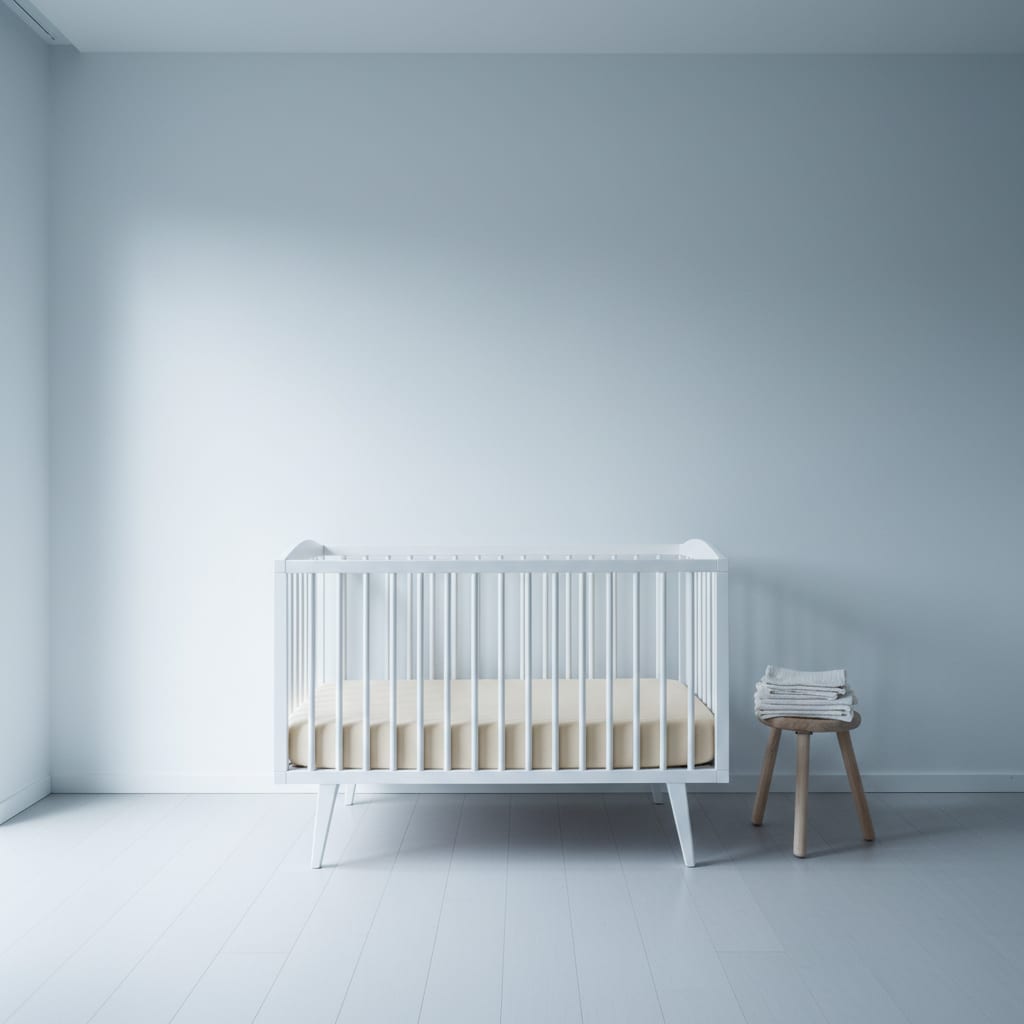
No. A baby with reflux still sleeps flat on their back, on a firm, level surface, alone in the space — the same rule as every other baby, with no exception carved out for spitting up. The American Academy of Pediatrics is explicit that elevating the head of a crib while a baby lies on their back doesn’t reduce reflux and is not recommended, and that positional therapy — head elevation, side-lying, tummy-lying — should not be used to treat reflux symptoms in sleeping infants.
I write about owning less. This is the one topic where the recommendation and the safety standard happen to be the same sentence, so it’s worth spelling out why.
The tilt doesn’t hold a baby where you think it does
The intuition is plumbing: milk goes down, gravity keeps it there. It’s a reasonable guess and it fails on contact with an actual infant.
A baby placed on a slope does not stay at the top of the slope. They slide. The AAP’s 2022 evidence review cites a biomechanical analysis finding that infants can’t be positioned at a 30-degree incline without sliding down — and a baby who has slid has ended up chin-to-chest, or wedged sideways against a raised edge, in a position that can compromise their breathing. The incline that was supposed to help is the thing that moved them.
There’s a second failure that matters more at three in the morning. An incline makes rolling easier in one direction and harder in the other. A baby on a tilted surface who gets themselves face-down is a baby who has to work uphill to get back, and until they can roll confidently both ways, that is a trip they may not be able to reverse. If the side-sleeping version of this question is the one you’re actually turning over, Betteroo covers the side-lying question in more detail than a blog about cupboards should, and I’ve written separately about why side-lying is the unstable middle position.
The category that got built, then banned
Here’s where my old job is relevant. I spent years as a retail buyer for a big-box chain, and the inclined-sleeper aisle is a textbook case of how a product category gets manufactured: identify a fear parents already have, produce an object shaped like an answer, and put it at eye level. Whether it works is not part of the process. Whether it looks like it works is the entire process.
That category is now largely illegal in the United States, and it took infant deaths to get there. Fisher-Price recalled roughly 4.7 million Rock ‘n Play Sleepers in April 2019 after dozens of reported infant deaths, and re-announced the recall in 2023 when more deaths were reported in products still in use. Congress then passed the Safe Sleep for Babies Act, signed in May 2022: as of November 2022, inclined sleepers for infants and crib bumpers are banned hazardous products, and the CPSC’s implementing rule defines an inclined sleeper as one with a sleep surface angled more than ten degrees, intended for infants up to a year old.
Two practical consequences. Second-hand is where recalled goods go to retire — a hand-me-down inclined sleeper, a marketplace bargain, a well-meant loan from a cousin whose baby “loved it” — and this is the one category where the doorway sort I usually apply to freebies and hand-me-downs has exactly one outcome. It doesn’t come in. And a ban on selling the object doesn’t stop the idea from being sold: wedges, positioners and “anti-reflux” pillows are still marketed under other headings. This site will not link one, at any price.
Raising the mattress is the same mistake, wearing a DIY hat
When the product is unavailable, the workaround appears: books under the crib legs, a rolled towel under the mattress, a folded blanket beneath the sheet, a foam wedge sold as a mattress accessory.
All of it is the same mechanism with worse engineering. The AAP’s position covers elevating the head of the crib specifically, and says plainly that it doesn’t work for reflux. Anything under or inside the mattress also compromises the flat, firm surface the crib was safety-tested with, and soft objects tucked into a sleep space are their own hazard entirely separate from the angle.
The crib’s whole inventory is three things: a firm flat mattress, a fitted sheet made for it, and the baby. If that looks under-furnished, that’s the correct look — and it’s the only shelf in this house where buying less isn’t a preference at all.
What’s left once the objects are gone
Not nothing — but very little of it is a purchase, which is why the aisle exists in the first place.
Awake, upright, supervised. Holding a baby upright after a feed is ordinary advice and doesn’t involve the sleep surface at all. The distinction is awake and held. A car seat, swing, bouncer or carrier is not a sleep space, and a baby who falls asleep in one gets moved to the flat crib.
Fewer clothes, more bibs and sheets. The genuinely useful response to a spitty baby is a laundry answer: a couple of extra fitted sheets sized to the mattress, and enough bibs and muslins that a change of outfit isn’t a crisis. Boring, cheap, actually works, and none of it enters the crib.
A conversation with your baby’s doctor. Most spitting-up is a laundry problem in a baby who is otherwise feeding well and gaining — the “happy spitter.” It commonly peaks in the early months and eases as the first year goes on. But poor weight gain, feeding refusal, distress, blood, breathing trouble or a baby who seems genuinely miserable is a call, not a Google search. Feed volumes, thickening, formula changes and medication are all decisions for a clinician, and I’m not going to hand out any of them from a blog about how much stuff a house needs.
For what reflux does to the shape of a night — the waking, the resettling, the part that isn’t about position — Betteroo’s guide to how reflux plays out across a night holds the same flat-and-on-the-back line this page does, which is the only reason it’s here.
FAQ: reflux, sleep and inclined surfaces
Can I elevate the head of the crib for reflux?
No. The AAP states that elevating the head of the crib while a baby is on their back is ineffective for reflux and is not recommended, and it raises the risk of the baby sliding into a position that compromises their breathing. Nothing goes under the mattress or the crib legs.
Are inclined sleepers still allowed?
Inclined sleepers for infants — products with a sleep surface angled more than ten degrees — have been banned hazardous products in the U.S. since November 2022 under the Safe Sleep for Babies Act. Don’t buy one second-hand, don’t accept one, and don’t keep one you already own.
What about a wedge that says it’s reflux-safe?
Don’t use it. Packaging is marketing, not a safety clearance, and positional therapy isn’t recommended for reflux in sleeping infants regardless of what the wedge is called. The sleep space holds a firm flat mattress, a fitted sheet and the baby.
My baby settles better propped up. Is that a signal?
It isn’t a safety signal. Babies often settle in positions that aren’t safe for them, and comfort doesn’t override the surface rule. If your baby seems genuinely distressed lying flat, that’s worth raising with your pediatrician directly rather than solving with an object.