№ 43
When a Toddler Will Only Sleep With One Specific Toy
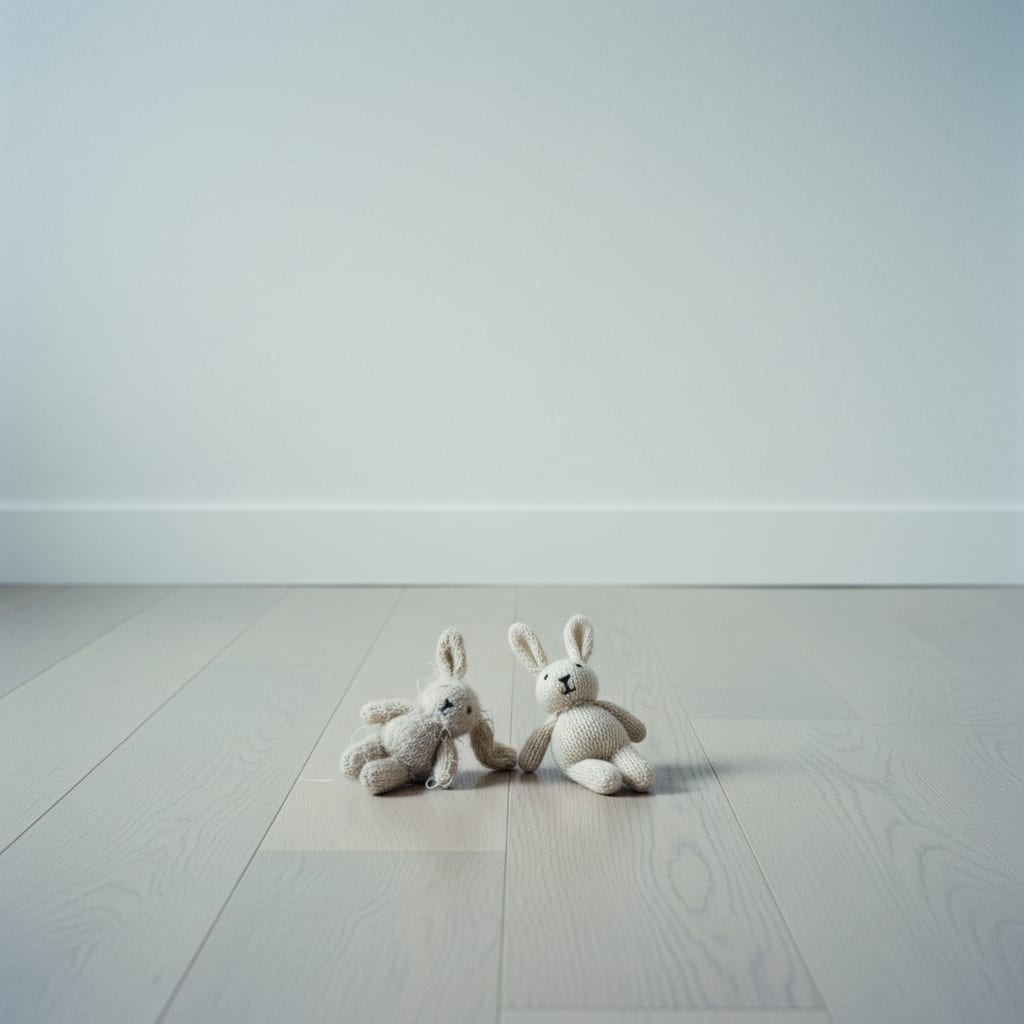
If your toddler will only fall asleep holding one particular rabbit, buy a second identical one — today, while it is still made — and rotate the two so that neither becomes the only one. That is the whole answer, and the one purchase on this site I would tell you to make twice. A house with less in it runs on things that earn their place, and this one earns it every single night.
Why no substitute works
The object is doing a real job, and the job is not “being soft” — soft is everywhere. The job is being this one: the same weave, the same weight, the same slightly wrong ear.
The American Academy of Pediatrics calls these transitional objects, and its guidance is worth reading before you worry: a child tends to make the choice “between months eight and twelve, and keep it for years to come”, and transitional objects “are not a sign of weakness or insecurity, and there’s no reason to keep your child from using one.”
So the specificity is not a fussiness to be trained out; it is the feature. A child cannot carry you into the dark, so they carry the one thing that is reliably, boringly, identically itself every night. Offer a newer or larger version and you have offered a different object.
I spent years deciding what earned shelf space in a big-box chain, where comfort is a category: a wall of plush, each with a story about being the one. Nobody has ever beaten a two-year-old on brand loyalty.
Buy the second one now
This is the AAP’s own advice, not mine: “You can also make things easier by having two identical security objects. Doing this allows you to wash one while the other is being used, thus sparing your baby (and yourself) a potential emotional crisis and a bedraggled lovey.”
Four rules make it work.
Buy the same thing, not the same idea. Same maker, same line, same size. A different animal from the same brand is a new object; so is the large version.
Buy it while it exists. Soft-goods lines are seasonal: a plush that was everywhere in spring is a discontinued colorway by autumn, and you will be bidding on a used one on the night you need it.
Rotate them. Two objects only help if both are the object. Swap every week or two so they wear and smell alike — same day, same detergent, never both in the wash at once. A spare sealed in a drawer for a year is a stranger, and will be rejected on sight at eleven at night.
Do not announce it. No ceremony, no “look, there are two now” — just swap. The magic is that the object appears continuous; a reveal breaks exactly that.
If you are still at the choosing stage, choose for reproducibility: something plain, washable and sold in multiples, so the duplicate is a two-minute purchase rather than a hunt. The aden + anais Essentials classic security blankets are the obvious worked example, because they come as an identical pair in the box — a cotton muslin square, nothing to break, no electronics, no licensed character whose rights will lapse.
Until the twin arrives, wash the original early enough to be dry and cool by bedtime and let the child watch it go in and come out. And when it starts to fall apart, repair rather than replace: a mended object is still the same object, a pristine new one is not.
When it is actually lost
Assume that at some point it will be. The order I would run it in:
- Stop searching in front of the child. A frantic adult turns a mislaid toy into an emergency. Search after bedtime.
- Tell the truth, small. “Bunny isn’t here tonight. She’ll be back.” Not a fiction that needs maintaining, and not a lecture.
- Bring the twin in without explanation, and move straight on to the next step.
- If there is no twin, do not substitute upward. A bigger, more exciting toy teaches that loss is rewarded with acquisition, and will not work anyway. Hold the routine steady instead — same order, same words, same lights. On a bad night the shape of the evening carries more than the object does, which is the argument for keeping the routine short enough to be repeatable in the first place.
- Then go and buy it. Exact product name first, then secondhand listings, then parent resale groups — the deepest market for discontinued plush. And photograph the one you still have, in daylight, both sides, tonight: a clear photo lets a stranger identify a nine-year-old colorway.
The one age line with no flexibility in it
Everything above is written about a toddler, and stops being true below about a year old. For a baby under one, the sleep space holds a firm flat mattress, a fitted sheet made for it, and the baby. No stuffed toys, no loveys, no pillows, no bumpers, no loose blankets. The AAP’s parent guide to safe sleep says to keep soft objects and loose bedding out of the sleep area, because they “can increase your baby’s risk of entrapment, suffocation or strangulation”, and states plainly that “unless mentioned otherwise, all these recommendations are for babies up to 1 year of age.” The NICHD’s Safe to Sleep campaign names loveys alongside pillows and stuffed toys among the things that do not belong there.
So before the first birthday a comfort object is a daytime object: fine for a cuddle or a stroller walk, out of the crib when the baby goes in. Betteroo’s guide covers the safety side of that first year in more detail, and it holds the same twelve-month line this page does, which is the only reason it is here.
Where it sits in a house with fewer things
This site runs on counts — how many soft toys live in the room and how many go in the bed, one in and one out, a shelf that decides. The required object is the standing exemption: it never leaves when something new arrives, it is not boxed for a season, and it is the one non-negotiable line on a packing list for a few nights elsewhere.
That is not an inconsistency in the philosophy; it is the philosophy. Buying less and buying right means being clear-eyed about which objects do work, and something that reliably ends the day does more work than anything else in the room. Exempting one and buying it twice costs less than the eleven substitutes you would otherwise accumulate trying to replace it.
How it usually ends
Not with a decision, and not with a plan of yours. The object’s territory shrinks: it stops going to the shops, then stops coming downstairs, then lives in the bed and is wanted only at bedtime, then only on hard nights — and one day you find it in a drawer and cannot remember when it was last asked for. The AAP’s phrasing is the honest timescale: kept “for years to come”.
Do not set a deadline — a date announced is a date to be fought over — and never use it as leverage. When it finally goes quiet, box it unwashed rather than throwing it out.
FAQ: the one toy they will not sleep without
Is it too late to buy a duplicate if the attachment has already formed? No, but rotate it in slowly: park the new one in the bed beside the original for a week or two before you swap them, so it picks up the right smell and wear. A twin introduced cold on a wash night will be spotted.
What if it has been discontinued? Buy every used one you can find in reasonable condition, and set an alert on the exact product name plus the colorway. If nothing exists, repair the original rather than upgrading.
Will having two weaken the attachment? It has not here, and the AAP recommends the pair specifically so you can wash one. The attachment is to a feel, not a serial number; two identical ones read as one object with better availability.
Does it count toward the two soft toys in the bed? No — it is the exempt item. If your child’s required object is a blanket rather than a plush, treat it the same way: bedding with a job, not one of the two.