№ 29
Sleeping Like a Baby: What Normal Infant Sleep Is
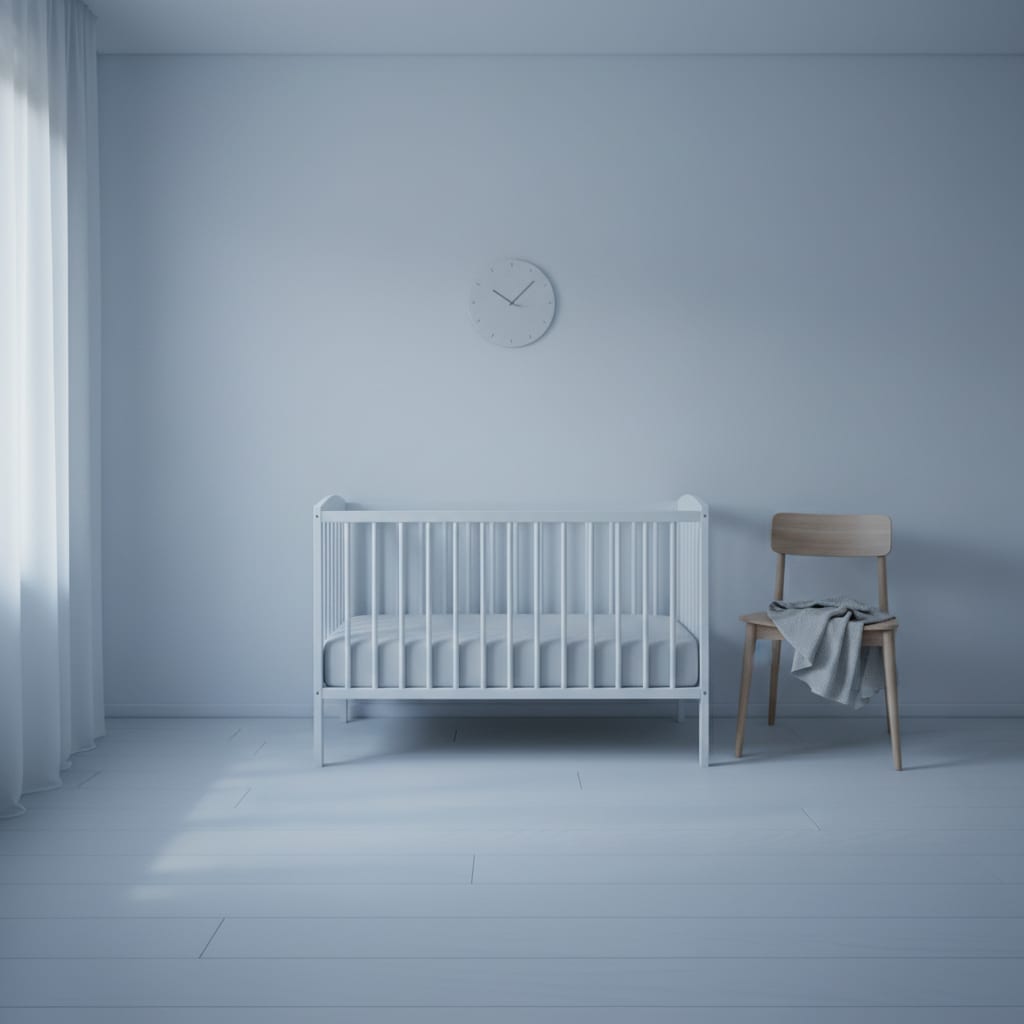
“Sleeping like a baby” describes something babies do not do. Normal infant sleep is short, broken and spread across the whole twenty-four hours: newborns need roughly 14 to 17 hours a day taken in fragments, older infants 12 to 15, and waking at night stays typical well past the first birthday. In one Montreal study, 38% of six-month-olds weren’t yet sleeping six straight hours. The gap between that reality and the phrase is not a parenting failure. It’s a market.
What normal infant sleep actually looks like
The numbers below come from the National Sleep Foundation’s 2015 expert-panel review (Hirshkowitz et al.). They are totals across a full day and night — not an unbroken block.
| Age | Total sleep per 24 hours |
|---|---|
| Newborn (0–3 months) | about 14–17 hours |
| Infant (4–11 months) | about 12–15 hours |
| Toddler (1–2 years) | about 11–14 hours |
| Preschool (3–5 years) | about 10–13 hours |
Three structural facts sit underneath those totals, and knowing them saves money.
Babies run shorter sleep cycles. An adult cycle is roughly 90 minutes; a young baby’s is closer to 50 or 60. More cycles means more surfacings a night, and each is a chance to wake fully rather than roll over. Architecture, not a fault.
The day–night clock isn’t installed at birth. A newborn’s circadian rhythm develops over the first couple of months, which is why a two-week-old treats 3am like 3pm. Nothing you buy accelerates that; daylight, feeds and time do the work.
“Sleeping through the night” has no agreed definition. In research it usually means five, six or eight consecutive hours. At a baby group it means twelve. Two meanings sharing one phrase is most of the misery.
On frequency: Pennestri and colleagues, in Pediatrics (2018), followed around 400 typically developing infants. At six months, 38% weren’t yet sleeping six consecutive hours and 57% weren’t sleeping eight. At twelve months, 28% still weren’t managing six and 43% weren’t managing eight — and the researchers found no association between sleeping through and mental or motor development, or with maternal mood. A quarter of one-year-olds not doing it isn’t a fringe outcome. It’s a normal column on the chart.
The gap between the phrase and the baby is the product
I spent years as a retail buyer for a big-box chain, deciding which objects earned shelf space, and this is the mechanism I know best: a product category needs a gap. Not a problem, exactly — a distance between what someone expects and what they’ve got. The wider the gap, the more the aisle sells, and nobody in the supply chain has an incentive to close it by adjusting the expectation.
Infant sleep has the widest gap in the store. Every parent arrives holding a phrase that promises unbroken bliss, meets a baby waking every two hours, and concludes something is broken and buyable. So the aisle fills: the swaddle that promises, the sack that promises more, the sound machine, the second sound machine, the smart sock, the projector, the vibrating bassinet, the wedge, the lounger, the pillow shaped like an answer.
Here’s what my old job taught me about that shelf. Almost none of it was designed against a sleep outcome, because sleep outcomes are unmeasurable at the till. It was designed against a feeling — the 2am certainty that there must be one more thing you haven’t tried. That feeling has no end point, which is why the category never stops expanding. Same machinery as how to stop buying toys, at a higher price and on less sleep.
Knowing what’s normal closes the gap from the other side, for free. A baby waking three times at eight months is not a problem you failed to buy the solution to. Betteroo’s guide to what to expect from sleep across the first year walks the stages calmly and does the same job this page does: reset the expectation rather than sell against it.
Four normal things that get sold as problems
Waking every two to three hours as a newborn. Small stomachs, short cycles, no clock. This is the design.
The four-month change. Sleep reorganises around three to four months as cycles mature — the famous “regression” is a permanent developmental step, not a malfunction. Plenty of gear is marketed straight into that window.
Only sleeping on you. Contact napping is common in the first months and, with safe-sleep rules kept for night sleep, it is not a habit you have ruined. This panic sells more inclined and lounger-shaped objects than any other, and those are the ones I’d part with first — my case is in why inclined sleep isn’t the fix.
Still feeding at night at eight, ten, twelve months. Common, and normal for many babies. Whether to change it is a conversation with your paediatrician, not a purchase.
None of that means you’re stuck. It means the first move is information, and information is free.
What a sleep setup needs once you subtract the gap
Short list — and here the tiny keep-count isn’t a minimalist preference, it’s the safe-sleep rule.
- A firm, flat mattress and a fitted sheet made for it. That’s the sleep surface, entire.
- Nothing else in the space for the first year. No pillows, bumpers, loose blankets or soft toys.
- A sleep sack, once swaddling ends, doing the job a blanket isn’t allowed to do.
- Blackout and a sound machine, if — and only if — the room is bright or the street is loud. Conditions, not defaults.
Four lines, three of them furniture. I name no products on purpose: baby gear from 0 to 12 months is Only Mom Reviews’ territory, and she tests it properly. My job is the count. The general version — one right thing instead of six hopeful ones — is buy less, buy right.
When it isn’t only the expectation
Resetting expectations does not fix everything, and pretending otherwise would be its own sales pitch.
Some of what wears families out is structural: a bedtime landing past overtiredness, wake windows out of step with the age, a nap schedule that quietly stopped working. Timing problems respond to a plan rather than to acceptance, and that’s where Betteroo’s day-by-day sleep plan has been useful in our house, at roughly $20 a month. A tool, not magic: it will not make a four-month-old sleep twelve hours, and anything promising that is selling the gap rather than closing it.
Some of it is medical. Poor weight gain, breathing that sounds laboured or pauses, a baby inconsolable rather than unsettled, snoring, or a parent genuinely not coping — that’s a call to your doctor or health visitor today, not a schedule question and definitely not a shopping question.
FAQ: normal baby sleep
At what age do babies actually sleep through the night?
There’s no age at which it reliably switches on. In the Pediatrics study above, 28% of twelve-month-olds still weren’t sleeping six consecutive hours. Many consolidate between six months and two years, some earlier, some much later — with no developmental difference between the groups.
Is it normal for a baby to wake every two hours?
For a newborn, yes — short cycles and small stomachs make it the expected pattern. Past about six months it’s still common but becomes more responsive to timing: bedtime, wake windows, how much day sleep lands and when. That’s the point where the schedule is worth more than the shop.
Do sleep products actually help babies sleep?
A few solve a real environmental problem — a dark room in a bright house, white noise on a loud street, a sack instead of a forbidden blanket. Most of the rest are sold against the anxiety rather than the sleep, and buying them tends to make the 2am feeling worse, because it confirms the answer is purchasable.
Where did “sleeping like a baby” even come from?
It’s an idiom about the look of infant sleep — the boneless, abandoned quality of a baby who’s out — not its duration. Somewhere along the way it got read as a promise about the night, and a retail category grew up in the space between the two meanings.
Should I worry if my baby sleeps outside the ranges above?
Ranges are guidance, not thresholds, and healthy babies vary either side of them. What’s worth a call is a change in pattern paired with something else — a baby suddenly much harder to rouse, feeding poorly, floppy or unwell. Bring the pattern to your paediatrician rather than to a chart.