№ 49
Crib Bumpers: Why the Crib Stays Bare, Even for a Toddler
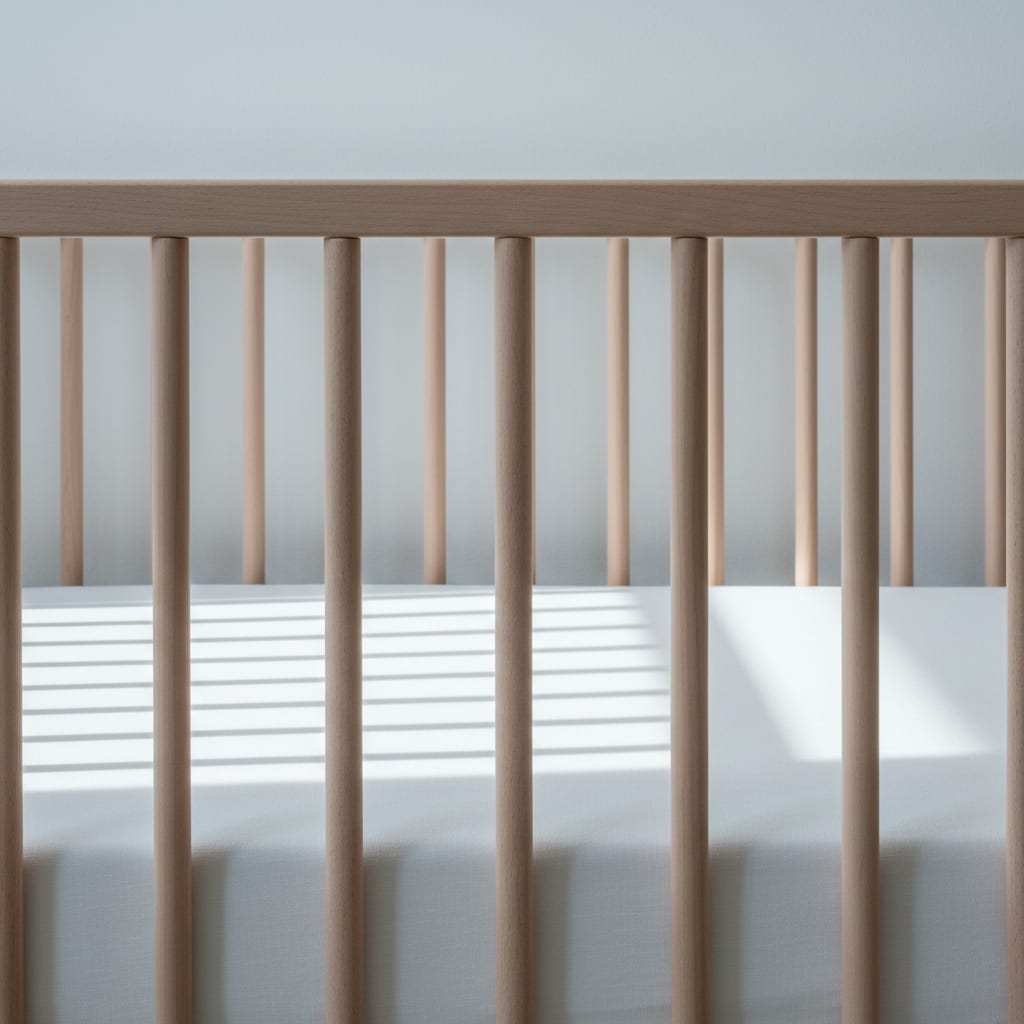
Crib bumpers stay out of the crib, for a baby and for a toddler who keeps bumping into the slats. For babies, the American Academy of Pediatrics lists bumper pads among the soft objects that raise the risk of entrapment, suffocation and strangulation, and since late 2022 federal law has treated crib bumpers as banned hazardous products. For a toddler, a bumper still doesn’t help. The AAP’s own room-safety page says there is no evidence bumpers prevent injuries, and that toddlers can use one to climb out. A bump against a slat is the smaller problem.
That leaves the crib with four things in it, and this is one of the few pages here where the minimalist answer and the safety answer are exactly the same.
What the law banned, in its own words
The Safe Sleep for Babies Act was signed on May 16, 2022. It gave a 180-day runway, after which crib bumpers, “regardless of the date of manufacture,” count as a banned hazardous product under the Consumer Product Safety Act. It’s the same law that banned inclined sleepers, which is the story told in the reflux and inclined-sleep post.
The definition is worth reading slowly, because it describes the toddler-bumping worry almost word for word. A crib bumper is “any material that is intended to cover the sides of a crib to prevent injury to any crib occupant from impacts against the side of a crib,” or to stop a child getting “any part of the body entrapped in any opening.” It names three kinds:
- a padded crib bumper;
- a “supported and unsupported vinyl bumper guard”;
- “vertical crib slat covers,” the padded sleeves that wrap each slat.
It also names one thing it does not cover: “a non-padded mesh crib liner.” That exclusion is where most of the remaining confusion lives.
The law is aimed at what can be sold, not at your nursery. But its reasoning applies at home: a product built to cushion a crib’s sides was judged too dangerous to sell.
Mesh liners: legal is not the same as recommended
The mesh liner is the version you’ll still find for sale, usually with “breathable” in the name. The AAP’s parent site, HealthyChildren, lists it among baby products to avoid, and its reasoning covers both ages:
- “most child health advocates, including the AAP, believe these liners are not necessary,” because modern cribs must have closely spaced slats;
- “crib liners can work their way loose and suffocate or trap a sleeping child”;
- “Toddlers have used them to jump or climb out of cribs, boosting risks for dangerous falls and head trauma.”
The AAP’s safe-sleep guide also doesn’t stop at padding. Its list of things to keep out of the sleep area ends with “bumper pads or related products that attach to crib slats or sides.” A mesh liner attaches to crib slats. So for safe-sleep purposes it’s in the same bin as the padded one.
The toddler who bumps into the slats
A toddler rolls a long way in a night, ends up sideways with a foot through the bars, and now and then knocks their head on a slat hard enough to wake. It looks like exactly the problem a bumper was made for. The AAP’s room-safety page is blunt about it: “Do not use bumper pads in cribs. There is no evidence that they prevent injuries,” and “toddlers can use a bumper guard to help them climb and fall out.”
That second point is the one that changes the arithmetic. A toddler who stands up in a crib uses anything along the rail as a step. A padded roll or a taut liner is a step. A climb over the rail ends on the floor, and a fall from the rail is a much bigger problem than a bump against a slat.
The dangerous version of slat contact is already designed out of a modern crib. HealthyChildren’s guide to a safe baby room says slats should be no more than 2 3/8 inches (6 cm) apart “so a child’s head cannot become trapped between them.” An old crib with wider gaps, missing slats or a drop side is the real problem, and no bumper fixes it.
The arm or leg poking through the bars is a nuisance rather than a hazard: free it, resettle, carry on. Betteroo’s longer walk-through of each type the law names makes one useful practical point: a sleep sack keeps both legs together inside the fabric, so a foot has a harder time sliding between the slats.
What a bare crib actually needs
Four things, and as a former buyer I’d be hard pressed to find a shorter list for anything sold to new parents.
- A firm, flat mattress that fits. HealthyChildren’s test is two fingers: “If you can insert more than two fingers between the mattress and the sides or ends of the crib, the crib and mattress combination should not be used.”
- A fitted sheet made for that mattress. NIH’s Safe to Sleep campaign puts it in one line: “Remove everything from baby’s sleep area, except a fitted sheet covering the mattress.”
- A wearable blanket for warmth. The AAP and Safe to Sleep both point to layers of clothing or a wearable blanket instead of anything loose. The worked example for a crib-age toddler is the HALO SleepSack in cotton, size large. One or two in rotation is the whole category.
- The child. On their back for every sleep in the first year, which is the rule behind why side sleeping isn’t the compromise it looks like.
The mattress height is part of the setup too. HealthyChildren says to lower it before a baby can sit and to set it “at its lowest position before your child learns to stand”. It also says to move a child to another bed “when he is 35 inches (89 cm) tall, or when the height of the side rail is less than three-quarters of his height (approximately nipple level).” A toddler near that line who is climbing is telling you the crib is finished. A bumper won’t extend its life.
What about the comfort object? Past the first birthday that’s a different question with its own answer, covered in the toddler who will only sleep with one toy. It still doesn’t include anything tied to the slats.
When a bumper arrives anyway
They still come into homes. A matching nursery bedding set from an older relative, a hand-me-down bag, a resale listing that should not exist. The minimalist rule and the safety rule agree here too. It doesn’t go in the crib, and it doesn’t get passed on. Donating or reselling a banned product just moves the risk to someone else’s baby.
The kind script for a relative is the same shape as every gift conversation: thank them for the thought, then name the replacement. “Safe-sleep advice is a completely bare crib now, so we’re using sleep sacks. Could the quilt be for the play mat instead?” Specific beats apologetic.
FAQ: crib bumpers and the bare crib
Are crib bumpers illegal? Selling them is. Under the Safe Sleep for Babies Act, crib bumpers have been banned hazardous products since late 2022, whenever they were made. The ban covers padded bumpers, vinyl bumper guards and slat covers. It doesn’t cover non-padded mesh liners.
Are mesh crib liners safe? They’re legal, but the AAP doesn’t recommend them. HealthyChildren says liners can work loose and trap or suffocate a sleeping child, and that toddlers have used them to climb out of cribs.
At what age can a toddler have a crib bumper? There isn’t one. Under one, bumpers are on the AAP’s keep-out list. Once a child can stand, any bumper or liner is a foothold for climbing out, and HealthyChildren says there’s no evidence they prevent injuries anyway.
My toddler keeps getting a leg stuck between the slats. What should I do? Free the leg and resettle them. A sleep sack makes it harder for one foot to slip through. If the gaps look wide, measure them: more than 2 3/8 inches means the crib itself needs replacing. If your child is hurting themselves at night, or bangs their head often enough to worry you, ask your pediatrician.