№ 25
Starting Solids at 6 Months: What You Actually Need
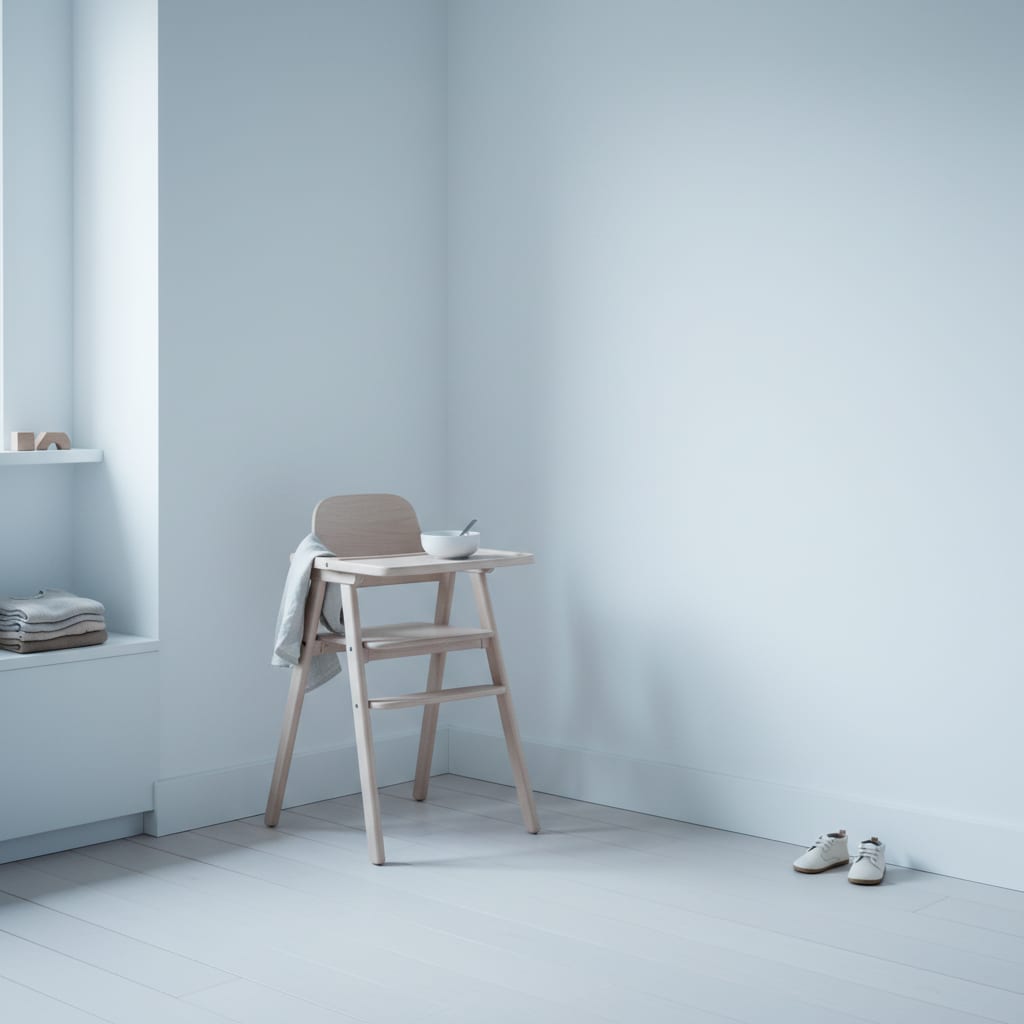
Far less than the aisle suggests. Functionally: somewhere for the baby to sit, something to eat off, something to wipe with, and a way to clean all three. That is the whole list, and most of it you already own. Starting solids isn’t a shopping event, but it is sold as one — it lands right as the newborn gift flow finally slows, and restarts it. When your child is ready, and which foods in which order, is a conversation with your paediatrician. What follows is only about the stuff.
Why this milestone arrives as an inflow event
I spent years deciding which products got shelf space in a big-box chain, and I can tell you that “starting solids” is one of the most reliably profitable moments in the whole parenting calendar. It has a date attached, it has an anxious buyer, and it has an enormous number of adjacent objects that can be described as necessary without anyone quite being able to prove it.
That’s not a conspiracy — it’s just good merchandising, and I helped design it. A milestone with a deadline converts. The bowls, the mats, the mesh feeders, the storage trays, the specialised utensils, the little machine that steams and blends and takes up a permanent square foot of counter: none of them are scams, and all of them are optional. The single most useful fact about weaning equipment is that most of the world does it with a chair, a spoon, and a cloth.
The other thing worth knowing is that this is a short season. Whatever you buy for it will be in the house for a matter of months in its intended use, and years afterwards in a cupboard.
The functional list, and nothing else
Here’s what the job actually requires, stated as functions rather than products:
- A place to sit. Upright, supported, at the height of the food. This is the one genuine decision, and it’s the one thing worth thinking about properly — more on that below.
- Something to eat off. A dish, a tray, a plate. You own these.
- Something to eat with. One small soft-tipped spoon. Two if you’d rather not wash one mid-meal.
- Something to catch the mess. A wipeable bib, or a cloth, or in warm weather a baby in a nappy and nothing else. Fabric bibs that need laundering create work; the wipe-clean kind ends the job at the sink.
- A way to clean the floor. Whatever you already clean the floor with.
Everything past that line is convenience, and convenience is fine — just buy it after you know you want it. The rule I’d apply: start with what you own, run two weeks, then buy the one thing whose absence you actually noticed. Almost nobody does this, because the shopping happens the week before the first spoonful, when the felt need is highest and the information is lowest. That gap between felt need and real information is where our houses fill up, and it’s the same gap buying less and buying right is meant to close.
What to say to the people already buying it
The bigger inflow problem isn’t your own spending. It’s that a visible milestone gives everyone who loves your baby a reason to send something, and weaning gear is cheap, cute and easy to post.
Two moves cover most of it.
Name the one thing. When someone asks what you need, answer with a specific item rather than “oh, nothing” — a vague answer gets replaced with an enthusiastic one. This is the same redirect that works on grandparents who overbuy: people want to participate, and the request is what steers them.
Sort at the doorway, not the cupboard. Second-hand feeding kit arrives in bulk, often in a bin bag, often from someone lovely. Decide what comes in before it’s put away, exactly as with any other hand-me-down haul — keep what you’ll use this season, and pass the rest on while it’s still in the bag. What gets shelved “just in case” is what you’ll be moving house with.
And if the gear is already arriving faster than you can decide about it, that’s an ordinary freebie flood with a new label on it, and it responds to the same doorway rule.
About the nights
The reason this post exists is that solids and sleep get tangled together, usually by someone confident at a family gathering. So, briefly and honestly: a fuller baby is not a reliably better sleeper, and I’d be careful with anyone who promises otherwise. The kitchen side of that question belongs to Hey Mom Blog, who handle what actually changes at night when solids start properly, with the cooking attached.
What I’d add from the stuff side is only this: the six-month mark is crowded. Solids often begin in the same fortnight that sleep gets choppy for entirely unrelated developmental reasons — and if you’ve just changed the food, the food is what gets blamed. Betteroo’s explainer on the sleep wobble that tends to hit around six months is worth reading before you rearrange the whole day around a spoon, as is their breakdown of how long a six-month-old can comfortably stay awake — the awake stretch before bed explains far more bad nights than dinner does.
Anything involving choking, allergies, reflux, poor weight gain or an allergen plan is a clinician’s territory, not a comment section’s, and not mine. Ask before you improvise.
Where the one real decision is
The chair is the purchase that deserves actual thought, because it’s the only item in this category that takes up floor space in a room you use every day, and because you’ll live with it for years rather than months. Footprint, not features, is the thing people get wrong — a chair that’s easy to wipe and small enough to leave out beats a clever one that gets folded away and resented.
That comparison isn’t ours to make; baby gear is Only Mom Reviews’ lane, and their high chairs measured by actual floor footprint is the piece I’d send a friend. Buy that one carefully. Improvise the rest.
Keeping the count after the milestone passes
Weaning gear has a habit of surviving its usefulness. The spoons migrate to the toy bin, the trays go to the back of a cupboard, the blender-steamer occupies the counter long after anyone purées anything.
Put an end date on it now. When your child is eating from ordinary plates with ordinary cutlery, the specialised objects leave the house — donated while they’re still wanted, not stored until they’re not. One pass, twenty minutes, no ceremony. The season’s over; the shelf should say so.
FAQ: starting solids and the stuff around it
Do I need a special baby food maker?
No. It’s a convenience appliance, and a good one for some households — but it earns counter space only if you know you’ll purée in volume. A pan and a fork, or a blender you already own, cover the same ground. Buy it after two weeks of wishing you had it, not before.
Are bowls with suction bases worth it?
They solve a real and specific problem: the airborne dish. If your baby is a thrower, one is genuinely useful. If they aren’t, it’s a bowl. This is a good example of the general rule — wait until the problem shows up, then buy the answer to that problem.
How much should I buy second-hand?
Most of it, happily — hard plastic and silicone clean up fine, and this category is full of barely-used things. The usual exceptions apply to anything with a safety function or a recall history, and to anything you can’t clean properly. Sort it at the door, keep what you’ll use this season, pass on the rest.
When should we actually start?
That’s a question for your paediatrician or health visitor, who knows your child. Readiness isn’t a birthday, the timing varies, and allergen introduction in particular is guidance I’m not going to hand out from a blog about cupboards.